

 Posts
Posts


Australia has started 2013 with a record-breaking heat wave that has lasted more than two weeks across many parts of the country. Temperatures have regularly gone above 48°C, with the highest recorded maximum of 49.6°C at Moomba in South Australia. The extreme conditions have been associated with a delayed onset of the Australian monsoon, and slow moving weather systems over the continent.What is causing Australia's heatwave?
Does the country's record-breaking heatwave have something to do with climate change?
Australia has always experienced heat waves, and they are a normal part of most summers. However, the current event affecting much of inland Australia has definitely not been typical.
The most significant thing about the recent heat has been its coverage across the continent, and its persistence.
It is very unusual to have such widespread extreme temperatures — and have them persist for so long. On those two metrics alone, spatial extent and duration, the last two weeks surpasses the only previous analogue in the historical record (since 1910) – a two-week country-wide hot spell during the summer of 1972-1973.
A good measure of the spatial extent of the heat is the Australian-averaged maximum daily temperature. This is the average of the highest daily temperature of the air just above the surface of the Australian continent, including Tasmania. The national average is calculated using a three-dimensional interpolation (including topography) of over 700 observing sites each day.
On Monday and Tuesday last week (January 7 and 8) that temperature rose to over 40°C. Monday's temperature of 40.33°C set a new record, beating the previous highest Australian daily maximum of 40.17°C set in 1972. Tuesday's temperature came in as the 3rd highest on record at 40.11°C.
Showing posts with label environment. Show all posts
Showing posts with label environment. Show all posts
Tuesday, January 29, 2013
Australia on the Front Line
Fascinating overview of Australia's record breaking temperatures. From The Guardian:


Thursday, January 3, 2013
Briony Penn Takes on Oilberta
Focus Magazine used to be this sleepy little mag read by seniors and, well, pretty much no-one else. But over the last couple of years, it has transformed itself into one of the most hard-hitting, deep-digging, and well-written magazines in Canada. And pretty much nobody outside Victoria knows about it.
We also have some of the smartest and most committed environmental activists in the world here. The local environment pretty much demands it of a person. There's Alexandra Morton taking on the fish farms of the Broughton Archipelago. David Suzuki just keeps getting smarter and more focused. And let's be frank; who else has elected a Green to Parliament? And then there's Briony Penn.
Yes, Briony is not unwilling to use pretty much any means to get an issue attention. She rode through Vancouver as Lady Godiva to bring attention to logging on Salt Spring Island. And, if you've seen Salt Spring
Island, youll know why she did it.
Briony is also an adjunct professor of environmental studies at the University of Victoria, and continues to write--currently in Focus Magazine. Where she has written this excellent article on the way the two sides are approaching the expansion of pipeline capacity through British Columbia.

We also have some of the smartest and most committed environmental activists in the world here. The local environment pretty much demands it of a person. There's Alexandra Morton taking on the fish farms of the Broughton Archipelago. David Suzuki just keeps getting smarter and more focused. And let's be frank; who else has elected a Green to Parliament? And then there's Briony Penn.
| photo from The Province newspaper |
Island, youll know why she did it.
 |
| Photo from findfamilyfun.com |
Despite [Ian Anderson, CEO of Kinder Morgan}'s claim to be committed to more genuine consultation, it’s not clear that he or any of his colleagues in the oil patch understand British Columbians’ deep opposition to exposing their land, rivers and sea to the risks posed by oil pipelines and tankers and our even broader concerns. Many of us are sensing that we are on the verge of environmental collapse and that any one of these major projects could put us over the edge. Gerald Amos, past chief councillor of the Kitimaat Village Council, at the end of Enbridge’s proposed pipeline between the tar sands and the coast, articulates the crucial point around consultation: “The big issue for communities—one that really hasn’t been grappled with yet—is the cumulative impact of what we call progress.”
Whether it’s Jasper grappling with the cumulative impacts of man-made corridors on wildlife populations; or Kitimaat with the rising toll of logging, mining, hydro projects and the eight proposed liquefied natural gas plants; or Victoria facing another 300 oil tankers in our waters each year to service the expanded Kinder Morgan depot, the big issue for British Columbians is not just the next big project planned, but the sum total of where we are going as a nation with our energy needs, our distribution, and the rate of exploitation.
Anderson’s speech suggested that he believes it’s a waste of time trying to educate British Columbians about the importance of the pipeline to national security, that we’re simply concerned about our own backyard. In reality, though, it’s Anderson who doesn’t understand the big picture.Read the article. Particularly if you're an Albertan--the days of blithely assuming that oil will sell, the economy will expand, and "Alberta will be the envy of the country," well, those days are over. BC is one of the reasons Harper decided to gut environmental protections in this country. We are squarely in the cross-hairs, and we know it. Ans still two thirds of BC residents are willing to flip him the bird. Harper's worried about bodies in front of bulldozers day after day on the news. He should be.
We get it that we are moving perilously close to the straw that breaks the camel’s back. Or, more aptly, in the case of the Rockies, the mountain caribou’s back. And on the coast, the southern resident orca’s (another species at risk) back. Environmental collapse cannot be addressed with such solutions as one discussed by the Heavy Oil club: saving caribou in the tar sands by fencing them into compounds to “mitigate” their decline.
“Cumulative impact” is the scientific term for what we intuitively sense is happening to our environment. While assessing such impacts is central to environmental assessments—and true national security—in jurisdictions around the planet, Canada’s policy on such matters, unfortunately, has regressed back to the 1950s.
Friday, December 28, 2012
Talk-aoke
This punches a lot of my buttons: open-source, community-based, inventive, alternative media. Essentially a talk show-styled piece, it took place at GreEngaged event during the Design Council week. The host acts mainly to draw out anyone who wants to speak, knowing that he can be replaced at any time by someone off the floor. The discussion here is about fashion and the environment, but the process would certainly be translatable to pretty much any event.
It's worth noting that haute couture operates in a copyright-free world, where everything can be stolena dn reproduced at a moments notice. And yet, somehow, the world of fashion manages to keep going.
It's worth noting that haute couture operates in a copyright-free world, where everything can be stolena dn reproduced at a moments notice. And yet, somehow, the world of fashion manages to keep going.
Tuesday, November 13, 2012
Worst Fears Being Realized?
There's an article at The Washington Post that talks about the accuracy of climate forecast models.
The IPCC report that set off panic in the boasrdrooms of the world's biggest corporations was not a worst case scenario report. Everything in it had to be vetted and approved by the governments involved, not just the scientists who wrote it. This meant that the report was closer to a best case rather than a wost case. Turns out that the worst case is the one that seems more likely. And just a reminder: atmospheric carbon has to stay below 350 ppm for the world to maintain the climate we've grown to depend on. Current levels are watching 390 ppm disappearing behind them.
No supercomputer is powerful enough to predict cloud cover decades into the future, so Fasullo and colleague Kevin Trenberth struck on another method to test which of the many climate simulations most accurately predicted clouds: They looked at relative humidity. When humidity rises, clouds form; drier air produces fewer clouds. That makes humidity a good proxy for cloud cover." “The models at the higher end of temperature predictions uniformly did a better job,” Fasullo said. The simulations that fared worse — the ones predicting smaller temperature rises — “should be outright discounted,” he said. " The models that predict less severe outcomes fared worse when tested against historical data. Just like Arctic ice cover is procceeding much more rapidly than expected.
Looking back at 10 years of atmospheric humidity data from NASA satellites, the pair examined two dozen of the world’s most sophisticated climate simulations. They found the simulations that most closely matched humidity measurements were also the ones that predicted the most extreme global warming.
In other words, by using real data, the scientists picked simulation winners and losers.
“The models at the higher end of temperature predictions uniformly did a better job,” Fasullo said. The simulations that fared worse — the ones predicting smaller temperature rises — “should be outright discounted,” he said.
The IPCC report that set off panic in the boasrdrooms of the world's biggest corporations was not a worst case scenario report. Everything in it had to be vetted and approved by the governments involved, not just the scientists who wrote it. This meant that the report was closer to a best case rather than a wost case. Turns out that the worst case is the one that seems more likely. And just a reminder: atmospheric carbon has to stay below 350 ppm for the world to maintain the climate we've grown to depend on. Current levels are watching 390 ppm disappearing behind them.
Monday, September 17, 2012
This Is Not An Enbridge Animation
From the Dogwood Initiative website:
Last Saturday, Dave Shortt emerged from 10 days of filming in the northern B.C. bush, found a wi-fi connection at the Kitimat library and happened upon a story online about Enbridge being criticized for deleting islands in the Douglas Channel from a video animation.
“I had this eureka moment,” Shortt says. The 38-year-old filmmaker had been filming along Enbridge’s proposed pipeline route with an eye to putting together a five-minute video to help raise awareness about the areas at risk and encourage people to sign Dogwood’s petition at notankers.ca.
“The plan was to film for another week or two but then I read the story about omitting the islands and I realized that’s what the video should be about,” he said on Wednesday afternoon from his camper van parked outside the Prince Rupert Safeway store. “It’s about trying to bring some reality to what’s at risk.”
Shortt knew the media interest in the missing islands would pass quickly, so he needed to get the video posted pronto. “It was 10 in the morning, but I still needed to finish filming because I didn’t have the shots of Kitimat yet,” Shortt says.
He quickly got the shots he needed, then headed back to the Kitimat library where he spent four hours editing the video — but then he hit a road block. “I had to sit as close to the wireless internet as possible, but it wasn’t suitable for uploading or transferring data. I realized it was going to be like three hours,” Shortt says.
While he battled with the wi-fi, Shortt’s friend asked the librarian if she knew anywhere with fast Internet in town and she recommended the rec centre. And that’s how it came to be that Shortt launched his soon-to-be-viral video into the world from the lobby of the Kitimat Rec Centre — humble beginnings for 100 seconds of footage that have been viewed more than 34,000 times in four days, driven 4,500 new signatures to the No Tankers petition and drawn the attention of the Huffington Post, Toronto Star, Vancouver Province and Canada AM.
Thursday, September 6, 2012
Tuesday, September 4, 2012
Environmental Overshoot
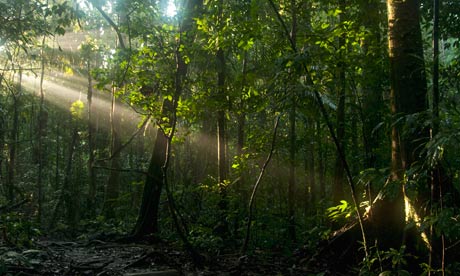 |
| Yasuni national park is the most biodiverse region on Earth. Photograph: Corbis via The Guardian |
From The Guardian:
In international bodies, biodiversity loss was long treated as a poor cousin to climate change. But this is changing amid growing awareness that both are approaching dangerous tipping points as a result of human pressures. Earlier this year, a group of leading scientists warned that biodiversity loss could result in a "global-scale state shift".
"Much as the consensus statements by doctors led to public warnings that tobacco use is harmful to your health, this is a consensus statement by experts who agree that loss of Earth's wild species will be harmful to the world's ecosystems and may harm society by reducing ecosystem services that are essential to human health and prosperity," noted Prof Bradley Cardinale, an associate professor at the University of Michigan who led the study published in Nature. "We need to take biodiversity loss far more seriously – from individuals to international governing bodies – and take greater action to prevent further losses of species."
But the trend is in the opposite direction. WWF says we are in an ecological overshoot situation in which it now takes 1.5 years for the Earth to regenerate what we use in a year. [emphasis mine]
Wednesday, February 16, 2011
Agent Provocateur
No, not the lingerie company. Rather the infiltration of civic groups (typically radical or interested in progressive causes) by police or other security organizations in order to incite violent or illegal actions. Like Mark Kennedy, recently outed in Britain as having spent years undercover in the UK environmental movement. And now the Guardian is reporting on three major energy firms that have employed private security firms to carry out covert intelligence-gathering operations on environmental activists and groups.
Governments in the UK have viewed environmental protest as potentially violent terrorism since at least the rule of Margret Thatcher. Infiltration with agent provocateurs in the US environmental movement go back to the monkeywrenchers of the 80s and even earlier (Nixon's enemy list shows that paranoia has long been a feature of the ruling class south of the border). In Canada, RCMP agent provocateurs were responsible for much of the paranoia around the French-Canadian separatist movement in the 1970s.
George Monbiot reports that he could not find "a single proven instance of a planned attempt in the UK to harm people in the cause of defending the environment". This jibes with reports from the mid-1980s here in the Pacific Northwest when a tremendous panic was being whipped up against "tree spiking," where large nails, it was claimed, were being pounded into trees in order to damage mill machinery. Despite the hysteria whipped up by the local media and public pronouncements from various logging companies, only one incident of possible tree spiking was reported when, in 1987, California mill worker George Alexander was seriously injured when the bandsaw he was operating was shattered by either an old nail or a tree spike. One unproven case of possible spiking became the basis for tree spiking being declared a federal felony in the United States in 1988.
The agent provocateur is an excellent tactic for keeping track of a group while simultaneously discrediting it. Which, of course is why it's used. But there are some actions that such agents really cannot guard against. Like the new Greenpeace ad.
Governments in the UK have viewed environmental protest as potentially violent terrorism since at least the rule of Margret Thatcher. Infiltration with agent provocateurs in the US environmental movement go back to the monkeywrenchers of the 80s and even earlier (Nixon's enemy list shows that paranoia has long been a feature of the ruling class south of the border). In Canada, RCMP agent provocateurs were responsible for much of the paranoia around the French-Canadian separatist movement in the 1970s.
George Monbiot reports that he could not find "a single proven instance of a planned attempt in the UK to harm people in the cause of defending the environment". This jibes with reports from the mid-1980s here in the Pacific Northwest when a tremendous panic was being whipped up against "tree spiking," where large nails, it was claimed, were being pounded into trees in order to damage mill machinery. Despite the hysteria whipped up by the local media and public pronouncements from various logging companies, only one incident of possible tree spiking was reported when, in 1987, California mill worker George Alexander was seriously injured when the bandsaw he was operating was shattered by either an old nail or a tree spike. One unproven case of possible spiking became the basis for tree spiking being declared a federal felony in the United States in 1988.
The agent provocateur is an excellent tactic for keeping track of a group while simultaneously discrediting it. Which, of course is why it's used. But there are some actions that such agents really cannot guard against. Like the new Greenpeace ad.
Monday, November 29, 2010
Liars, Damned Liars and the Conservative Party
The Toronto Star / Canadian Press Service are reporting that despite repeated claims that the Canadian government would address global warming and GHG emissions in step with the United States, Environment Minister John Baird has stated that this will not happen.
With the failure to institute cap and trade in the US, the Obama administration has announced a "Plan B," passed by executive order, that strengthens the EPA regulation over greenhouse gasses. To quote the article:
Frankly, this position is absurd. It is the equivalent to suggesting that because Alberta has argued with, and been in contravention of, aspects of our national healthcare program, that this invalidates Medicare. It was not true in the case of Medicare, and it certainly isn't true in the case of the new EPA regulations.
The Conservative Party has been relying on the American Republicans tactics of lies, denial, and fear to keep any meaningful change in American policy on GHGs from being enacted. With the strengthening of EPA regulation by the White House, this claim that "when the Americans do something, we'll do something" has been rendered moot. The Americans have done something-- and, importantly, something that could make a difference here in Canada. They have targeted GHG emissions from stationary sources. In Canada, that means only one thing; the Alberta tar sands projects.
If the Conservatives were to actually harmonize Canadian environmental regulation with the US, this would force greater efficiencies on the tar sands projects, possibly restricting their (currently a cancer-like unrestrained) growth. It would do nothing to address the appalling waste handling in the tar sands, nor would it do anything to deal with tailpipe emissions (a 1970s problem addressed by a Conservative proposal to harmonize Canadian regulation with American earlier this year).
The Conservative Party under Stephen Harper has made it abundantly clear that they will not, under any circumstances, do anything that might slow the exploitation of the tar sands, or that would impose any kind of regulation on them. This does, from their point of view, make sense; any regulation of the tar sands would raise, in Alberta, the spectre of the hated National Energy Program. Which, of course, would mean political suicide for the Tories in Oilberta. The Tories have recognized that opposing corporate interests, particularly in the oil patch, particularly in Alberta, is a non-starter. This despite the fact that most Albertans couldn't have told you what the NEP was about in the '70s, never mind now.
In our current irony-impaired environment, Baird made his comments while preparing to attend the United Nations Climate Change Conference that begins this week in Cancun, Mexico.
With the failure to institute cap and trade in the US, the Obama administration has announced a "Plan B," passed by executive order, that strengthens the EPA regulation over greenhouse gasses. To quote the article:
The first step tightens rules for existing facilities planning any expansion that would increase emissions. Then, starting in July, the rules will be extended to include newly constructed facilities.Although the EPA regulations are national, Texas has announced that the state will refuse to meet the federal guidelines. Baird offers the excuse that because of this refusal, this makes the US regulations "not national."
The EPA says its regulations target operations that produce nearly 70 per cent of U.S. greenhouse gas emissions from stationary sources.
The agency estimates the more stringent rules will require first-time permits for about 550 sources between 2011 and 2013. It also expects an additional 900 permits for new and modified projects each year.
Frankly, this position is absurd. It is the equivalent to suggesting that because Alberta has argued with, and been in contravention of, aspects of our national healthcare program, that this invalidates Medicare. It was not true in the case of Medicare, and it certainly isn't true in the case of the new EPA regulations.
The Conservative Party has been relying on the American Republicans tactics of lies, denial, and fear to keep any meaningful change in American policy on GHGs from being enacted. With the strengthening of EPA regulation by the White House, this claim that "when the Americans do something, we'll do something" has been rendered moot. The Americans have done something-- and, importantly, something that could make a difference here in Canada. They have targeted GHG emissions from stationary sources. In Canada, that means only one thing; the Alberta tar sands projects.
If the Conservatives were to actually harmonize Canadian environmental regulation with the US, this would force greater efficiencies on the tar sands projects, possibly restricting their (currently a cancer-like unrestrained) growth. It would do nothing to address the appalling waste handling in the tar sands, nor would it do anything to deal with tailpipe emissions (a 1970s problem addressed by a Conservative proposal to harmonize Canadian regulation with American earlier this year).
The Conservative Party under Stephen Harper has made it abundantly clear that they will not, under any circumstances, do anything that might slow the exploitation of the tar sands, or that would impose any kind of regulation on them. This does, from their point of view, make sense; any regulation of the tar sands would raise, in Alberta, the spectre of the hated National Energy Program. Which, of course, would mean political suicide for the Tories in Oilberta. The Tories have recognized that opposing corporate interests, particularly in the oil patch, particularly in Alberta, is a non-starter. This despite the fact that most Albertans couldn't have told you what the NEP was about in the '70s, never mind now.
In our current irony-impaired environment, Baird made his comments while preparing to attend the United Nations Climate Change Conference that begins this week in Cancun, Mexico.
Friday, October 15, 2010
Water
I currently live in a temperate rainforest--or what used to be one. I live next to the ocean beside a park that is at or below the high tide level and only survives because of the massive amounts of fill that was trucked in 60 years ago. For six months of the year, we are regularly inundated with rain. And yet...and yet...for at least two months a year, this temperate rainforest does without rain.
Previous to moving back here, my family and I spent 14 years living on a farm north of Edmonton, Alberta. By the time we left, we had watched the land dry out and drift in front of the wind, like snow in winter.
For most of the time we lived on the farm, the biggest problems were getting water into the house, and getting water out of the house. We had a dug well (as opposed to a drilled well), which meant that we were dependent on water held in the first thirty metres or so of soil. The first five years, I climbed down the well and scooped the dead gophers (technically, Richardson's Ground Squirrels) off the surface of the water two or three times a year. Eventually we re-dug the well and solved that problem. But in the meantime, we just boiled water and tried not to think about it.
The water we drank, cooked, and generally used wasn't great--it had a high nitrate content--but it was usable. Unlike, say, the Athabasca River running past Fort MacMurray and the oilsands. But the Athabasca River only affects the Northern Cree of Oilberta, so that really doesn't count.
I had never thought of there being a water problem in Alberta. There had always been water while I was growing up there. The winters had snow, the spring, summer, and fall had rain. And when you turned the tap on, water came out--as much as you could want.
But there were a few factors that I wasn't aware of, growing up. Like Edmonton hadn't yet reached a million people, as it did a couple of years back. That glacial run-off did a good job of maintaining summertime flow in the North Saskatchewan River, just like it did in the Bow River running through Calgary. And the big one; that we were living through the wettest century in two thousand years.
Alberta wasn't even a century old as a province back then. All our weather and water information was based on the century we were living through. We had been through six major drought events, including the "Dirty Thirties," but those events were anomalies, unusual, abnormal. the problem wasn't availability of water, but the distribution. And so the provincial government subsidized irrigation projects aimed at the area south of red Deer, and planned a massive water diversion project that would take the water flowing north and re-direct it south. Part of it for southern agriculture, and part of it for export into the United States. As the oil-patch became the primary political driver in the province, permits for water were approved that removed acre-feet of potable water out of the southern river systems to pump down played-out oil wells, forcing the last of the oil out and permanently removing the now-contaminated water from the water cycle.
And even though Alberta elects its governments for multi-decade reigns, there was, and is, no long-term thinking about resource issues in the province. Especially water issues. There is resource "management," where fair access is managed, but never any thinking about whether water should be used in the ways we use it.
And getting water in and out of the house is really one of the driving forces of civilization, like access to food and taxation. Here where I live now, in Victoria, there's a major fight going on over sewage treatment--aka getting water out of the house. In Alberta, there's agreements in place with Saskatchewan over how much water can be taken by each province out of shared rivers, but there's no thinking about how much water is needed by the river system. We don't simply need batter water management in Canada, we need a serious re-think about how we relate to water. After all, without water there's not really much point to anything else, is there?
Previous to moving back here, my family and I spent 14 years living on a farm north of Edmonton, Alberta. By the time we left, we had watched the land dry out and drift in front of the wind, like snow in winter.
For most of the time we lived on the farm, the biggest problems were getting water into the house, and getting water out of the house. We had a dug well (as opposed to a drilled well), which meant that we were dependent on water held in the first thirty metres or so of soil. The first five years, I climbed down the well and scooped the dead gophers (technically, Richardson's Ground Squirrels) off the surface of the water two or three times a year. Eventually we re-dug the well and solved that problem. But in the meantime, we just boiled water and tried not to think about it.
The water we drank, cooked, and generally used wasn't great--it had a high nitrate content--but it was usable. Unlike, say, the Athabasca River running past Fort MacMurray and the oilsands. But the Athabasca River only affects the Northern Cree of Oilberta, so that really doesn't count.
I had never thought of there being a water problem in Alberta. There had always been water while I was growing up there. The winters had snow, the spring, summer, and fall had rain. And when you turned the tap on, water came out--as much as you could want.
But there were a few factors that I wasn't aware of, growing up. Like Edmonton hadn't yet reached a million people, as it did a couple of years back. That glacial run-off did a good job of maintaining summertime flow in the North Saskatchewan River, just like it did in the Bow River running through Calgary. And the big one; that we were living through the wettest century in two thousand years.
Alberta wasn't even a century old as a province back then. All our weather and water information was based on the century we were living through. We had been through six major drought events, including the "Dirty Thirties," but those events were anomalies, unusual, abnormal. the problem wasn't availability of water, but the distribution. And so the provincial government subsidized irrigation projects aimed at the area south of red Deer, and planned a massive water diversion project that would take the water flowing north and re-direct it south. Part of it for southern agriculture, and part of it for export into the United States. As the oil-patch became the primary political driver in the province, permits for water were approved that removed acre-feet of potable water out of the southern river systems to pump down played-out oil wells, forcing the last of the oil out and permanently removing the now-contaminated water from the water cycle.
And even though Alberta elects its governments for multi-decade reigns, there was, and is, no long-term thinking about resource issues in the province. Especially water issues. There is resource "management," where fair access is managed, but never any thinking about whether water should be used in the ways we use it.
And getting water in and out of the house is really one of the driving forces of civilization, like access to food and taxation. Here where I live now, in Victoria, there's a major fight going on over sewage treatment--aka getting water out of the house. In Alberta, there's agreements in place with Saskatchewan over how much water can be taken by each province out of shared rivers, but there's no thinking about how much water is needed by the river system. We don't simply need batter water management in Canada, we need a serious re-think about how we relate to water. After all, without water there's not really much point to anything else, is there?
Tuesday, January 5, 2010
Some American Numbers
But can Canada be far behind?

Statistically SPEAKING
Because we’re rarely far from a well-stocked supermarket or convenient drive-thru, many Americans aren’t aware of the worrisome trend toward monoculture in our agricultural ecosystems. But the loss of diversity in the plants we eat should give us all food for thought.
Our food supply by the numbers:
Approximate number of plants that are edible:
30,000
Of those, how many have people consumed throughout history:
10,000
Of those, how many make up the basis of our diets today:
150
Of those, how many provide 80 percent of the world’s food:
12
Of those, how many provide 60 percent of the world’s food:
4*
Percent of genetic diversity lost in agricultural crops over the last century:
75 percent
*(Note: You get extra credit if you guessed which four crops these are: Wheat, rice, maize and potatoes.)
Statistics courtesy of: Dean Bill Chameides’ blog, The Green Grok, thegreengrok.com
Approximate number of plants that are edible:
30,000
Of those, how many have people consumed throughout history:
10,000
Of those, how many make up the basis of our diets today:
150
Of those, how many provide 80 percent of the world’s food:
12
Of those, how many provide 60 percent of the world’s food:
4*
Percent of genetic diversity lost in agricultural crops over the last century:
75 percent
*(Note: You get extra credit if you guessed which four crops these are: Wheat, rice, maize and potatoes.)
Statistics courtesy of: Dean Bill Chameides’ blog, The Green Grok, thegreengrok.com
Powered by ScribeFire.
Tuesday, December 29, 2009
The Road to 350: part 1
So post-Copennhagen, it is clear that our national governments are going to be little if no help in getting us back under 350 ppm of CO². At least, not now and not for a while. Unless you live in Germany, which has taken its environmental responsibilities quite a bit more seriously since Kyoto than our Canadian national government ever did. Between '97 and '07, Germany reduced its emissions by about 6%. Canada's have risen by a similar amount. But Under the Harper Conservatives, we've also become an international pariah nation; the Commonwealth is moving to kick Canada out because of our obstructionist tactics viz. global warming at the last couple of meetings for example.
And our behaviour at Copenhagen was pathetic at best (I hope the Honourable Jim Prentice was suitably embarrassed at giving Harper's speech for him, that he refuses such an assignment again. If our PM really had the strength of his own convictions, he'd have given the speech himself).
But what is made clear from Copenhagen is the strength and impact of our provincial and municipal governments in addressing climate change. We need the federal government to step up, but until they do, there is a lot that can be accomplished at the municipal and provincial level. Say what you will about Gordon Campbell (and he likely deserves it), at least he appears to have heard about global warming and the need to reduce carbon emissions. And he has, however poorly executed or followed up on, instituted a carbon tax in BC.
So getting to 350 (or less, as several undeveloped nations suggested at Copenhagen), is going to be tricky. No one wants to go first, extractive businesses don't want to go at all, and most of us have no idea how to move forward. So where do we start?
On a personal level, the most effect you can have is not, funnily enough, to stop driving. Yes, that's a good idea. And we need more people on transit to make it carbon-effective (a replacement I humbly offer up for "cost-effective"). But the number one action we can take is to significantly reduce our intake of animal protein. If we each restricted our diet tomorrow to three servings of animal protein a week, we could change to world. Well, as long as we didn't allow the surplus to be exported.
The energy input costs for animal protein are in excess of 30-1. Thirty calories in for every calorie out. That's a recipe for disaster in any system. And I can't think of any "green meat" (with the possible exception of a couple of backyard chickens), Dr. Seuss notwithstanding.

Weapon of Global destruction.
I'm as guilty as anyone; I purchase cruelty-free pork from my local grocer (who gets only two hogs/week to sell; so small producer and local), but that doesn't really change the carbon footprint of the meat that much. And its not transportation that's the culprit. It's the raising of the animal that causes the most problems.
According to the Food and Agriculture Organization (in 2006):
When emissions from land use and land use change are included, the livestock sector accounts for 9 percent of CO2 deriving from human-related activities, but produces a much larger share of even more harmful greenhouse gases. It generates 65 percent of human-related nitrous oxide, which has 296 times the Global Warming Potential (GWP) of CO2. Most of this comes from manure.
And it accounts for respectively 37 percent of all human-induced methane (23 times as warming as CO2), which is largely produced by the digestive system of ruminants, and 64 percent of ammonia, which contributes significantly to acid rain.
Worldwide, about 13.5% of GHGs are produced by transportation in various forms. Livestock, worldwide, contribute about 18% of the world's GHGs (at least in 2006).
In Canada, 55% of nitrogen fertilizer is used to produce feed and pasture forage, also according to the FAO. In Germany, that number is 62%, and in the UK, 70%. The raising of calories to feed livestock is a massive energy sink.
Worldwide, since the signing of the Kyoto protocol, meat consumption has gone from 214,940,709 metric tonnes in 1997, to 246,771,601 tonnes in 2002 (the last year for which records are available), a net increase of 31,830,892 tonnes in five years. (In Canada it was 2,906,689 tonnes to 3,380,823 tonnes in the same period--a period during which our corruption index (Bribe Payer's Index (Transparency International) Units: index units: 10=bribes never occur; 1=bribes often occur) went from 8.1 in 1999 to 7.5 in 2006. Though this may have a lot more to do with our descent into petro-state status (see Andrew Nikiforuk).

And our behaviour at Copenhagen was pathetic at best (I hope the Honourable Jim Prentice was suitably embarrassed at giving Harper's speech for him, that he refuses such an assignment again. If our PM really had the strength of his own convictions, he'd have given the speech himself).
But what is made clear from Copenhagen is the strength and impact of our provincial and municipal governments in addressing climate change. We need the federal government to step up, but until they do, there is a lot that can be accomplished at the municipal and provincial level. Say what you will about Gordon Campbell (and he likely deserves it), at least he appears to have heard about global warming and the need to reduce carbon emissions. And he has, however poorly executed or followed up on, instituted a carbon tax in BC.
So getting to 350 (or less, as several undeveloped nations suggested at Copenhagen), is going to be tricky. No one wants to go first, extractive businesses don't want to go at all, and most of us have no idea how to move forward. So where do we start?
On a personal level, the most effect you can have is not, funnily enough, to stop driving. Yes, that's a good idea. And we need more people on transit to make it carbon-effective (a replacement I humbly offer up for "cost-effective"). But the number one action we can take is to significantly reduce our intake of animal protein. If we each restricted our diet tomorrow to three servings of animal protein a week, we could change to world. Well, as long as we didn't allow the surplus to be exported.
The energy input costs for animal protein are in excess of 30-1. Thirty calories in for every calorie out. That's a recipe for disaster in any system. And I can't think of any "green meat" (with the possible exception of a couple of backyard chickens), Dr. Seuss notwithstanding.
Weapon of Global destruction.
I'm as guilty as anyone; I purchase cruelty-free pork from my local grocer (who gets only two hogs/week to sell; so small producer and local), but that doesn't really change the carbon footprint of the meat that much. And its not transportation that's the culprit. It's the raising of the animal that causes the most problems.
According to the Food and Agriculture Organization (in 2006):
When emissions from land use and land use change are included, the livestock sector accounts for 9 percent of CO2 deriving from human-related activities, but produces a much larger share of even more harmful greenhouse gases. It generates 65 percent of human-related nitrous oxide, which has 296 times the Global Warming Potential (GWP) of CO2. Most of this comes from manure.
And it accounts for respectively 37 percent of all human-induced methane (23 times as warming as CO2), which is largely produced by the digestive system of ruminants, and 64 percent of ammonia, which contributes significantly to acid rain.
Worldwide, about 13.5% of GHGs are produced by transportation in various forms. Livestock, worldwide, contribute about 18% of the world's GHGs (at least in 2006).
In Canada, 55% of nitrogen fertilizer is used to produce feed and pasture forage, also according to the FAO. In Germany, that number is 62%, and in the UK, 70%. The raising of calories to feed livestock is a massive energy sink.
Worldwide, since the signing of the Kyoto protocol, meat consumption has gone from 214,940,709 metric tonnes in 1997, to 246,771,601 tonnes in 2002 (the last year for which records are available), a net increase of 31,830,892 tonnes in five years. (In Canada it was 2,906,689 tonnes to 3,380,823 tonnes in the same period--a period during which our corruption index (Bribe Payer's Index (Transparency International) Units: index units: 10=bribes never occur; 1=bribes often occur) went from 8.1 in 1999 to 7.5 in 2006. Though this may have a lot more to do with our descent into petro-state status (see Andrew Nikiforuk).
Powered by ScribeFire.
Friday, December 25, 2009
Running, Not Walking
Visualize the planet as a globe. Now put a belt around it. Put another belt above and below that one. These are climatic zones; and they are expanding. The belt around the middle is widening, and the one above and the one below are slipping up towards the poles as the middle one gets bigger. How fast is this happening? About 0.42 kilometres (0.26 miles) per year. But that speed is not constant. To quote from the Carnegie Institute for Science release:
The researchers found that as a global average, the expected temperature velocity for the 21st century is 0.42 kilometers (0.26 miles) per year. But this figure varies widely according to topography and habitat. In areas of high topographic relief, where species can find cooler temperatures by climbing a nearby mountain, velocities are relatively low. In flatter regions, such as deserts, grasslands, and coastal areas, species will have to travel farther to stay in their comfort zone and velocities may exceed a kilometer per year.
That's fast. Forests may have moved that fast after the last ice age, but they didn't then face the fragmented landscape they now face. Agricultural land, cities, etc. mean that a lot of species--not just plants and trees, but vertebrates and invertebrates--may have simply nowhere to go. The question is not whether they can adapt to shifting climate zones, but whether they can move with the zone they currently live in. Below is an interview with Chris Field, director of the Carnegie Institution’s Department of Global Ecology and a co-author of the study on the speed of climate movement.

The researchers found that as a global average, the expected temperature velocity for the 21st century is 0.42 kilometers (0.26 miles) per year. But this figure varies widely according to topography and habitat. In areas of high topographic relief, where species can find cooler temperatures by climbing a nearby mountain, velocities are relatively low. In flatter regions, such as deserts, grasslands, and coastal areas, species will have to travel farther to stay in their comfort zone and velocities may exceed a kilometer per year.
That's fast. Forests may have moved that fast after the last ice age, but they didn't then face the fragmented landscape they now face. Agricultural land, cities, etc. mean that a lot of species--not just plants and trees, but vertebrates and invertebrates--may have simply nowhere to go. The question is not whether they can adapt to shifting climate zones, but whether they can move with the zone they currently live in. Below is an interview with Chris Field, director of the Carnegie Institution’s Department of Global Ecology and a co-author of the study on the speed of climate movement.
Powered by ScribeFire.
Sunday, December 20, 2009
Post-Copenhagen
So what did Canada get from our little trip to Copenhagen? Well, our PM made it clear that when it comes to photo opportunities, he's your guy--witness all the shots with various heads of state on his carbon-intensive journey pre-Copenhagen. But when it comes to facing up to the results of his beliefs and actions, he's really not so ready to get in front of a camera (well, to be fair, with the exception of his trip to China where only the sight of him crawling would really satisfy the Chinese leadership. But I think back to a year ago when Harper wouldn't face parliament after a major miscalculation either. Not really good at owning up to mistakes, our PM.). So poor old Jim Prentiss was trotted out to deliver 9 paragraphs of irrelevancy.
But Canada did get what our government wanted; nothing really changed. A vague commitment to reduce our emissions by 20% from 2006 levels (non-binding and unenforceable) and a promise to contribute to an international fund (dollars that are likely to come out of our current Foreign Affairs budget anyway).
But in terms of real change? Well, all we're going to get is more of the same. Enbridge is trying to build a pipeline across northern BC to haul bitumen (our vaunted "heavy oil") from Fort MacMurray to a tanker terminal at Prince Rupert. The Dogwood Initiative is working hard to keep that from happening, and is experiencing some success. But the extraction at the oil sands is still set to expand without any controls or limitations.
Which is one of the reasons Harper was willing to eat shit in China; China doesn't care what people do in their own country, as long as they fulfil their contractual obligations. So war criminal, genocidal lunatic, or environmental criminal, none of it matters as long as the resources keep flowing. And the US has pointed out that it does have some reservations about Alberta's bitumen extraction process. Several states are now refusing to accept oil from the tar sands, and President Obama announced on his arrival in Copenhagen that the EPA was going to be able to regulate CO² emissions. So Canada is facing growing restrictions on its ability to export dirty oil to the US.
As an aside, the move to declare CO² a pollutant and regulate it through the EPA is an important step for the US. Recent studies have indicated that the introduction of pollution controls in the US in the 1970s was important to the US remaining an economic powerhouse through the rest of the century. By forcing industries to clean up their act, the US government forced production efficiencies on those industries, making them much more competitive. This despite the extra imposed costs. It seems obvious that the same reasoning and results would apply to restrictions on CO².
So our PM, having no intention of imposing restrictions of any type on Alberta's bitumen production (he is, after all, the son of an oil executive, and beholding to oil companies), has realized that its necessary to find new markets that will not put restrictions on methods of production. Enter China.
China indicated at Copenhagen that while they are willing to agree to CO² reductions, they really have no interest in international verification procedures. Regretfully, NASA failed the launch of a satellite capable of doing that monitoring; currently the satellite rests on the bottom of the ocean near the Antarctic ice shelf. So until the US comes up with another 230 million dollars, international monitoring of CO² emissions is nothing but a dream.
But despite their dislike of international monitoring, China bids fair to become the renewable/green energy powerhouse of the 21st century. With the ability to totally ignore local opposition, China has begun building large wind and solar installations to supplement their coal and oil power producing infrastructure. In Canada, we've lost that opportunity with the Harper government's decision to spend infrastructure funds on partisan projects. Instead of taking the opportunity to help Canada into the 21st century, Harper decided instead to continue to believe that its the 1950s, and spend on old school projects. And unless there's someone presenting an oversized Conservative-logo'd novelty cheque, good luck on finding out where our billions of dollars are being spent. The Bush regime perfected the art of spending the country into impotence as a technique of hobbling future governments. Harper does it by cutting taxes (yes, we've gone from an inherited 13 billion surplus back to deficit spending--mostly down to Harper's cutting of the GST and other taxes)(as an aside, I'm actually in favour of taxes like the GST/HST; being strictly consumption-based and applying across the board, they tend to act to discourage spending and encourage saving).
So post-Copenhagen, we're really no further along to where we need to be. No international binding agreement on CO² reduction. The sea levels continue to rise, the poles continue to melt, the death of billions over the next 50-100 years still looms, and future of human life on Earth still hangs in the balance.
But Canada did get what our government wanted; nothing really changed. A vague commitment to reduce our emissions by 20% from 2006 levels (non-binding and unenforceable) and a promise to contribute to an international fund (dollars that are likely to come out of our current Foreign Affairs budget anyway).
But in terms of real change? Well, all we're going to get is more of the same. Enbridge is trying to build a pipeline across northern BC to haul bitumen (our vaunted "heavy oil") from Fort MacMurray to a tanker terminal at Prince Rupert. The Dogwood Initiative is working hard to keep that from happening, and is experiencing some success. But the extraction at the oil sands is still set to expand without any controls or limitations.
Which is one of the reasons Harper was willing to eat shit in China; China doesn't care what people do in their own country, as long as they fulfil their contractual obligations. So war criminal, genocidal lunatic, or environmental criminal, none of it matters as long as the resources keep flowing. And the US has pointed out that it does have some reservations about Alberta's bitumen extraction process. Several states are now refusing to accept oil from the tar sands, and President Obama announced on his arrival in Copenhagen that the EPA was going to be able to regulate CO² emissions. So Canada is facing growing restrictions on its ability to export dirty oil to the US.
As an aside, the move to declare CO² a pollutant and regulate it through the EPA is an important step for the US. Recent studies have indicated that the introduction of pollution controls in the US in the 1970s was important to the US remaining an economic powerhouse through the rest of the century. By forcing industries to clean up their act, the US government forced production efficiencies on those industries, making them much more competitive. This despite the extra imposed costs. It seems obvious that the same reasoning and results would apply to restrictions on CO².
So our PM, having no intention of imposing restrictions of any type on Alberta's bitumen production (he is, after all, the son of an oil executive, and beholding to oil companies), has realized that its necessary to find new markets that will not put restrictions on methods of production. Enter China.
China indicated at Copenhagen that while they are willing to agree to CO² reductions, they really have no interest in international verification procedures. Regretfully, NASA failed the launch of a satellite capable of doing that monitoring; currently the satellite rests on the bottom of the ocean near the Antarctic ice shelf. So until the US comes up with another 230 million dollars, international monitoring of CO² emissions is nothing but a dream.
But despite their dislike of international monitoring, China bids fair to become the renewable/green energy powerhouse of the 21st century. With the ability to totally ignore local opposition, China has begun building large wind and solar installations to supplement their coal and oil power producing infrastructure. In Canada, we've lost that opportunity with the Harper government's decision to spend infrastructure funds on partisan projects. Instead of taking the opportunity to help Canada into the 21st century, Harper decided instead to continue to believe that its the 1950s, and spend on old school projects. And unless there's someone presenting an oversized Conservative-logo'd novelty cheque, good luck on finding out where our billions of dollars are being spent. The Bush regime perfected the art of spending the country into impotence as a technique of hobbling future governments. Harper does it by cutting taxes (yes, we've gone from an inherited 13 billion surplus back to deficit spending--mostly down to Harper's cutting of the GST and other taxes)(as an aside, I'm actually in favour of taxes like the GST/HST; being strictly consumption-based and applying across the board, they tend to act to discourage spending and encourage saving).
So post-Copenhagen, we're really no further along to where we need to be. No international binding agreement on CO² reduction. The sea levels continue to rise, the poles continue to melt, the death of billions over the next 50-100 years still looms, and future of human life on Earth still hangs in the balance.
Monday, December 7, 2009
Meanwhile, Here At Home
From The Guardian:
Attempts have been made to break into the offices of one of Canada's leading climate scientists, it was revealed yesterday. The victim was Andrew Weaver, a University of Victoria scientist and a key contributor to the work of the Inter-governmental Panel on Climate Change (IPCC). In one incident, an old computer was stolen and papers were disturbed.
In addition, individuals have attempted to impersonate technicians in a bid to access data from his office, said Weaver. The attempted breaches, on top of the hacking of files from British climate researcher Phil Jones, have heightened fears that climate-change deniers are mounting a campaign to discredit the work of leading meteorologists before the start of the Copenhagen climate summit tomorrow.
"The key thing is to try to find anybody who's involved in any aspect of the IPCC and find something that you can … take out of context," said Weaver. The prospect of more break-ins and hacking has forced researchers to step up computer security.
Attempts have been made to break into the offices of one of Canada's leading climate scientists, it was revealed yesterday. The victim was Andrew Weaver, a University of Victoria scientist and a key contributor to the work of the Inter-governmental Panel on Climate Change (IPCC). In one incident, an old computer was stolen and papers were disturbed.
In addition, individuals have attempted to impersonate technicians in a bid to access data from his office, said Weaver. The attempted breaches, on top of the hacking of files from British climate researcher Phil Jones, have heightened fears that climate-change deniers are mounting a campaign to discredit the work of leading meteorologists before the start of the Copenhagen climate summit tomorrow.
"The key thing is to try to find anybody who's involved in any aspect of the IPCC and find something that you can … take out of context," said Weaver. The prospect of more break-ins and hacking has forced researchers to step up computer security.
The International Editorial
Copenhagen climate change conference: 'Fourteen days to seal history's judgment on this generation'
This editorial calling for action from world leaders on climate change is published today by 56 newspapers around the world in 20 languages
Copenhagen climate change summit - opening day liveblog
- The Guardian, Monday 7 December 2009
- Article history

Today 56 newspapers in 45 countries take the unprecedented step of speaking with one voice through a common editorial. We do so because humanity faces a profound emergency.
Unless we combine to take decisive action, climate change will ravage our planet, and with it our prosperity and security. The dangers have been becoming apparent for a generation. Now the facts have started to speak: 11 of the past 14 years have been the warmest on record, the Arctic ice-cap is melting and last year's inflamed oil and food prices provide a foretaste of future havoc. In scientific journals the question is no longer whether humans are to blame, but how little time we have got left to limit the damage. Yet so far the world's response has been feeble and half-hearted.
• How the Copenhagen global leader came about
• Write your own editorial
• Bryony Worthington: How to make an impact
• In pictures: How newspapers around the world ran the editorial
Climate change has been caused over centuries, has consequences that will endure for all time and our prospects of taming it will be determined in the next 14 days. We call on the representatives of the 192 countries gathered in Copenhagen not to hesitate, not to fall into dispute, not to blame each other but to seize opportunity from the greatest modern failure of politics. This should not be a fight between the rich world and the poor world, or between east and west. Climate change affects everyone, and must be solved by everyone.
The science is complex but the facts are clear. The world needs to take steps to limit temperature rises to 2C, an aim that will require global emissions to peak and begin falling within the next 5-10 years. A bigger rise of 3-4C — the smallest increase we can prudently expect to follow inaction — would parch continents, turning farmland into desert. Half of all species could become extinct, untold millions of people would be displaced, whole nations drowned by the sea. The controversy over emails by British researchers that suggest they tried to suppress inconvenient data has muddied the waters but failed to dent the mass of evidence on which these predictions are based.
Few believe that Copenhagen can any longer produce a fully polished treaty; real progress towards one could only begin with the arrival of President Obama in the White House and the reversal of years of US obstructionism. Even now the world finds itself at the mercy of American domestic politics, for the president cannot fully commit to the action required until the US Congress has done so.
But the politicians in Copenhagen can and must agree the essential elements of a fair and effective deal and, crucially, a firm timetable for turning it into a treaty. Next June's UN climate meeting in Bonn should be their deadline. As one negotiator put it: "We can go into extra time but we can't afford a replay."
At the deal's heart must be a settlement between the rich world and the developing world covering how the burden of fighting climate change will be divided — and how we will share a newly precious resource: the trillion or so tonnes of carbon that we can emit before the mercury rises to dangerous levels.
Rich nations like to point to the arithmetic truth that there can be no solution until developing giants such as China take more radical steps than they have so far. But the rich world is responsible for most of the accumulated carbon in the atmosphere – three-quarters of all carbon dioxide emitted since 1850. It must now take a lead, and every developed country must commit to deep cuts which will reduce their emissions within a decade to very substantially less than their 1990 level.
Developing countries can point out they did not cause the bulk of the problem, and also that the poorest regions of the world will be hardest hit. But they will increasingly contribute to warming, and must thus pledge meaningful and quantifiable action of their own. Though both fell short of what some had hoped for, the recent commitments to emissions targets by the world's biggest polluters, the United States and China, were important steps in the right direction.
Social justice demands that the industrialised world digs deep into its pockets and pledges cash to help poorer countries adapt to climate change, and clean technologies to enable them to grow economically without growing their emissions. The architecture of a future treaty must also be pinned down – with rigorous multilateral monitoring, fair rewards for protecting forests, and the credible assessment of "exported emissions" so that the burden can eventually be more equitably shared between those who produce polluting products and those who consume them. And fairness requires that the burden placed on individual developed countries should take into account their ability to bear it; for instance newer EU members, often much poorer than "old Europe", must not suffer more than their richer partners.
The transformation will be costly, but many times less than the bill for bailing out global finance — and far less costly than the consequences of doing nothing.
Many of us, particularly in the developed world, will have to change our lifestyles. The era of flights that cost less than the taxi ride to the airport is drawing to a close. We will have to shop, eat and travel more intelligently. We will have to pay more for our energy, and use less of it.
But the shift to a low-carbon society holds out the prospect of more opportunity than sacrifice. Already some countries have recognized that embracing the transformation can bring growth, jobs and better quality lives. The flow of capital tells its own story: last year for the first time more was invested in renewable forms of energy than producing electricity from fossil fuels.
Kicking our carbon habit within a few short decades will require a feat of engineering and innovation to match anything in our history. But whereas putting a man on the moon or splitting the atom were born of conflict and competition, the coming carbon race must be driven by a collaborative effort to achieve collective salvation.
Overcoming climate change will take a triumph of optimism over pessimism, of vision over short-sightedness, of what Abraham Lincoln called "the better angels of our nature".
It is in that spirit that 56 newspapers from around the world have united behind this editorial. If we, with such different national and political perspectives, can agree on what must be done then surely our leaders can too.
The politicians in Copenhagen have the power to shape history's judgment on this generation: one that saw a challenge and rose to it, or one so stupid that we saw calamity coming but did nothing to avert it. We implore them to make the right choice.
This editorial will be published tomorrow by 56 newspapers around the world in 20 languages including Chinese, Arabic and Russian. The text was drafted by a Guardian team during more than a month of consultations with editors from more than 20 of the papers involved. Like the Guardian most of the newspapers have taken the unusual step of featuring the editorial on their front page.
This editorial is free to reproduce under Creative Commons

'Fourteen days to seal history's judgment on this generation' by The Guardian is licensed under a Creative Commons Attribution-No Derivative Works 2.0 UK: England & Wales License.
Based on a work at guardian.co.uk.
Permissions beyond the scope of this license may be available at http://www.guardian.co.uk/environment/2009/sep/02/guardian-environment-team
(please note this Creative Commons license is valid until 18 December 2009)
Tuesday, December 1, 2009
Monbiot Comes To Canada
From The Guardian:
So writes George Monbiot in The Guardian today. I think my favourite line is "[Canada] is now to climate what Japan is to whaling." Although he gets one thing wrong; when he says that Canada is "turning itself into a corrupt petro-state," I'd have to point out that Alberta's been one for forty or fifty years, and the Canadian government has been following suit since Mulroney at least.
Heard Andrew Nikiforuk talk this past week. He too calls Canada a corrupt petro-state. In his recent book, Tar Sands: Dirty Oil and the Future of a Continent, he carefully explains the defining characteristics of a petro-state and how Alberta and Canada fit that definition. He then sums it up with what should be a rallying cry (but will never be so): There is no representation without taxation. In his article Declaration of a Political Emergency (pdf) he continues; "Oil hinders democracy and corrupts the political process through the absence of transparent reporting and clear fiscal accounting. Alberta, a classic petrostate, has one of the least accountable governments in Canada as well as the lowest voter turnout."
When you think of Canada, which qualities come to mind? The world's peacekeeper, the friendly nation, a liberal counterweight to the harsher pieties of its southern neighbour, decent, civilised, fair, well-governed? Think again. This country's government is now behaving with all the sophistication of a chimpanzee's tea party. So amazingly destructive has Canada become, and so insistent have my Canadian friends been that I weigh into this fight, that I've broken my self-imposed ban on flying and come to Toronto.
So here I am, watching the astonishing spectacle of a beautiful, cultured nation turning itself into a corrupt petro-state. Canada is slipping down the development ladder, retreating from a complex, diverse economy towards dependence on a single primary resource, which happens to be the dirtiest commodity known to man. The price of this transition is the brutalisation of the country, and a government campaign against multilateralism as savage as any waged by George Bush.
So writes George Monbiot in The Guardian today. I think my favourite line is "[Canada] is now to climate what Japan is to whaling." Although he gets one thing wrong; when he says that Canada is "turning itself into a corrupt petro-state," I'd have to point out that Alberta's been one for forty or fifty years, and the Canadian government has been following suit since Mulroney at least.
Heard Andrew Nikiforuk talk this past week. He too calls Canada a corrupt petro-state. In his recent book, Tar Sands: Dirty Oil and the Future of a Continent, he carefully explains the defining characteristics of a petro-state and how Alberta and Canada fit that definition. He then sums it up with what should be a rallying cry (but will never be so): There is no representation without taxation. In his article Declaration of a Political Emergency (pdf) he continues; "Oil hinders democracy and corrupts the political process through the absence of transparent reporting and clear fiscal accounting. Alberta, a classic petrostate, has one of the least accountable governments in Canada as well as the lowest voter turnout."
Monday, November 23, 2009
and England's dreaming...
Well, it's worked. We're all going to die, and it will be ugly. From The Guardian:
Climate change sceptics and fossil fuel companies that have lobbied against action on greenhouse gas emissions have squandered the world's chance to avoid dangerous global warming, a key adviser to the government has said.
Professor Bob Watson, chief scientist at the Department for Environment and Rural Affairs, said a decade of inaction on climate change meant it was now virtually impossible to limit global temperature rise to 2C. He said the delay meant the world would now do well to stabilise warming between 3C and 4C.
His comments come ahead of key UN negotiations on a new global climate treaty in Copenhagen next month that the UK government insists should still aim for a 2C goal, despite doubts over whether a meaningful deal can be sealed.
In an interview with the Guardian, Watson said: "Those that have opposed a deal on climate, which would include elements of the fossil fuel industry, have clearly made making a 2C target much, much harder, if not impossible. They've clearly put the world at risk of far more adverse effects of climate change."
Water gone, across the board decreases in cereal grain production, sea level rise, and inconsistent weather patterns (meaning no year-over-year understanding of what the weather is likely to do, to say nothing of more and more frequent extreme weather events), man, the next century is going to really suck.
The UN released a press release today saying that we've never (since recording started in the late 1700s) seen GHG levels this high (CO², methane, and nitrous oxide).

Powered by ScribeFire.
Wednesday, November 11, 2009
Peak Oil
According to The Guardian:

The world is much closer to running out of oil than official estimates admit, according to a whistleblower at the International Energy Agency who claims it has been deliberately underplaying a looming shortage for fear of triggering panic buying.
The senior official claims the US has played an influential role in encouraging the watchdog to underplay the rate of decline from existing oil fields while overplaying the chances of finding new reserves.
The allegations raise serious questions about the accuracy of the organisation's latest World Energy Outlook on oil demand and supply to be published tomorrow – which is used by the British and many other governments to help guide their wider energy and climate change policies.
Listen to an audio clip with Terry Macalister here.
A report by the UK Energy Research Council (UKERC) said worldwide production of conventionally extracted oil could "peak" and go into terminal decline before 2020.
The world has used less than half of the planet's conventionally extracted oil, but the remaining resources will be more difficult and expensive to get out of the ground, slowing production and increasing prices of crude.
With exploitation of the world's reserves running at more than 80m barrels a day, even major new discoveries such as the oil fields recently found in the Gulf of Mexico by BP would only delay a peak by a few days or weeks, the report said as reported by The Guardian.
The report, from the Peak Oil group, warns that the problem of declining availability of oil will hit the UK earlier than generally expected - possibly within the next five years and as early as 2011. [Also reported in The Guardian]
We don't have any plans in place to deal with peak oil: in Canada, we import the oil we use, and export the oil we produce (leaving most of us feeling WTF?). We peak out, everything falls apart. Our government is in denial, our corporate heads seem to be suffering a complete meltdown,and the general public just doesn't want to know. Any wonder why I'm a bit despairing of our future?
Powered by ScribeFire.
Thursday, October 29, 2009
Canada and the World
Even 20 months ago, no one knew what 350 meant, nor why it mattered. That's less than 2 years back. Then 10,000 year old ice sheets disappeared in the Arctic, Stephen Harper got a north of 60 hard-on, the IPCC released a report based on data that was already out of date (some of it a decade out of date), and a book detailing how James Hansen's work was censored came out. We shook our collective head, and some of us began to realize that we had entered what James Kunstler has called The Long Emergency.
It didn't take long to realize that 350 was the upper limit of atmospheric CO2 that could be considered "safe" (meaning that we might be able to keep global warming to 2°C and we might be able to live with the consequences of that rise), and here we are today looking at 390 ppm of carbon dioxide, no significant efforts being made to reduce carbon emissions, and a future that's looking at a minimum of 4°C warming and 6 metres of sea level rise--meanwhile emissions continue to increase and atmospheric CO2 rises at about 2ppm/year.
Here in Canada, we've got a Conservative government that is lead by a Prime Minister who still yet to convince anyone that he actually believes global warming may be a problem. Stephen "American Corporate Lackey" Harper is busy fiddling while the globe--including the nation of which he is nominally a member--burns. All our divorced-from-reality leader can see is the NorthWest Passage opening up and all that lovely ocean open to commercial exploitation.
Last week, the British Meteorological Office released a map of what we can expect to happen when we hit 4°C. The equatorial countries will get hotter, true, but the further you get from the equator, the more extreme the changes. But even now, Environment Minister Jim Prentice wants special treatment for Canada, allowing us--well, really just Alberta and the oil sands--to continue increasing our GHG emissions, while insisting that developing nations like China and India agree to hard caps that we ourselves will not accept. And the Canadian Government still refuses to release specifics of its plan to reduce our GHG emissions by 20% from our 2006 levels--which is light-years from our commitment under Kyoto.
Today comes the release of a new report. Quite unlike anything released in Canada before, it was financed by the Toronto Dominion Bank, produced by the Pembina Institute and the David Suzuki Foundation, with economic modeling by the well-respected economic consultants, M.K. Jaccard and Associates Inc. As John Ibbitson writes in the Globe and Mail; "A major bank has paid two environmental organizations to produce a groundbreaking report that, for the first time, calculates the costs of both the Harper government's modest plans to reduce greenhouse-gas emissions and the much more ambitious targets set by the environmental community, nationally and regionally."
The report offers a regional breakdown of economic impacts based on both the Harper government's vague commitment to 20% by 2020 (from 2006 levels) and the impact from the deeper and harder cuts that environmentalists are calling for and that would put Canada in line with our international obligations. And guess what? Neither scenario would kill us!
According to the report,"The Conservative government's goal of reducing greenhouse-gas emissions by 20 per cent by 2020 can be achieved, but only by limiting growth in Alberta and Saskatchewan." Alberta's growth would be 8.5% less in 2020 than it would be under a BAU (Business As Usual) approach, the report concludes. Under the same scenario, Saskatchewan would lose 2.8% of its projected growth. Central Canada, on the other hand, might well see some additional growth added to its projection. To quote Shawn McCarthy's article in the G&M; "Despite the steep costs involved in meeting targets, the analysis concludes the Canadian economy would continue to grow, albeit at a slower pace, and that investment in renewable energy and efficiency measures would result in an overall increase in employment compared to a “business-as-usual” scenario.
And even with the significant reduction in Alberta's potential growth and employment prospects, the province would still lead the country economically over the next 10 years."
So our economy would continue to grow AND there would probably be an increase in employment as well. And the cost? A reduction in projected growth an Alberta and Saskatchewan, and a significant out-migration from both provinces back to central Canada.
To further quote Shawn McCarthy's article: "TD's chief economist, Don Drummond, said the bank has not endorsed any targets, though it has supported a policy of a national emissions cap. He said the bank's interest was to shed light on an area where there has been little informed debate: the likely cost of imposing regulations."
I'm actually not seeing any real downside here. The Globe and Mail editorial board does though. In today's editorial, we read: "[T]he study acknowledges that what is proposed is no less than an economic upheaval: “There is a migration of capital and labour out of carbon and trade exposed sectors (e.g., fossil fuels) to sectors that are less carbon and trade exposed (e.g., manufacturing, services and renewable electricity).”
Canada cannot take its national unity for granted and must not, in the service of international obligations, allow itself to be immolated by a government policy of such wrenching dislocation." And the editorial concludes: "[T]he target [of carbon dioxide emission reduction] may be unreachable without unacceptable damage to Canada's economy and national unity. In which case, it is time for new targets, and new policies."
I can't help but think that no-one raised much of a stink about the "wrenching dislocation" caused by the development of the oil sands on the communities of Atlantic Canada. And even Jeffrey Simpson concludes that the Harper government's targets are just so much smoke being blown up our collective asses.
And so we have serious economic modelling of the potential and problems with trying to meet our international obligations regarding global warming and CO2 emissions. And we can now point to the report and say, "Tough, yes. But it won't kill us, and will probably make us stronger." And what of the complaints sure to come from the political and ruling classes of Alberta and Saskatchewan? Well, both provinces have had a great decade, with both provinces posting significant surpluses in their budgets, and neither has done a damn thing to prepare for the inevitable crash (particularly Alberta under Ralph Klein). For Alberta, that's two oil-based booms they've pissed away under Conservative governments. So honestly, I have no great sympathy for the Alberta government. And regardless of any future whining, we can look at the economic model contained in the M.K. Jaccard and Associates Inc. report, and read again the conclusion that "even with the significant reduction in Alberta's potential growth and employment prospects, the province would still lead the country economically over the next 10 years." And the planet (well, the human part of it) would thank us for facing up to our responsibilities.

It didn't take long to realize that 350 was the upper limit of atmospheric CO2 that could be considered "safe" (meaning that we might be able to keep global warming to 2°C and we might be able to live with the consequences of that rise), and here we are today looking at 390 ppm of carbon dioxide, no significant efforts being made to reduce carbon emissions, and a future that's looking at a minimum of 4°C warming and 6 metres of sea level rise--meanwhile emissions continue to increase and atmospheric CO2 rises at about 2ppm/year.
Here in Canada, we've got a Conservative government that is lead by a Prime Minister who still yet to convince anyone that he actually believes global warming may be a problem. Stephen "American Corporate Lackey" Harper is busy fiddling while the globe--including the nation of which he is nominally a member--burns. All our divorced-from-reality leader can see is the NorthWest Passage opening up and all that lovely ocean open to commercial exploitation.
Last week, the British Meteorological Office released a map of what we can expect to happen when we hit 4°C. The equatorial countries will get hotter, true, but the further you get from the equator, the more extreme the changes. But even now, Environment Minister Jim Prentice wants special treatment for Canada, allowing us--well, really just Alberta and the oil sands--to continue increasing our GHG emissions, while insisting that developing nations like China and India agree to hard caps that we ourselves will not accept. And the Canadian Government still refuses to release specifics of its plan to reduce our GHG emissions by 20% from our 2006 levels--which is light-years from our commitment under Kyoto.
Today comes the release of a new report. Quite unlike anything released in Canada before, it was financed by the Toronto Dominion Bank, produced by the Pembina Institute and the David Suzuki Foundation, with economic modeling by the well-respected economic consultants, M.K. Jaccard and Associates Inc. As John Ibbitson writes in the Globe and Mail; "A major bank has paid two environmental organizations to produce a groundbreaking report that, for the first time, calculates the costs of both the Harper government's modest plans to reduce greenhouse-gas emissions and the much more ambitious targets set by the environmental community, nationally and regionally."
The report offers a regional breakdown of economic impacts based on both the Harper government's vague commitment to 20% by 2020 (from 2006 levels) and the impact from the deeper and harder cuts that environmentalists are calling for and that would put Canada in line with our international obligations. And guess what? Neither scenario would kill us!
According to the report,"The Conservative government's goal of reducing greenhouse-gas emissions by 20 per cent by 2020 can be achieved, but only by limiting growth in Alberta and Saskatchewan." Alberta's growth would be 8.5% less in 2020 than it would be under a BAU (Business As Usual) approach, the report concludes. Under the same scenario, Saskatchewan would lose 2.8% of its projected growth. Central Canada, on the other hand, might well see some additional growth added to its projection. To quote Shawn McCarthy's article in the G&M; "Despite the steep costs involved in meeting targets, the analysis concludes the Canadian economy would continue to grow, albeit at a slower pace, and that investment in renewable energy and efficiency measures would result in an overall increase in employment compared to a “business-as-usual” scenario.
And even with the significant reduction in Alberta's potential growth and employment prospects, the province would still lead the country economically over the next 10 years."
So our economy would continue to grow AND there would probably be an increase in employment as well. And the cost? A reduction in projected growth an Alberta and Saskatchewan, and a significant out-migration from both provinces back to central Canada.
To further quote Shawn McCarthy's article: "TD's chief economist, Don Drummond, said the bank has not endorsed any targets, though it has supported a policy of a national emissions cap. He said the bank's interest was to shed light on an area where there has been little informed debate: the likely cost of imposing regulations."
I'm actually not seeing any real downside here. The Globe and Mail editorial board does though. In today's editorial, we read: "[T]he study acknowledges that what is proposed is no less than an economic upheaval: “There is a migration of capital and labour out of carbon and trade exposed sectors (e.g., fossil fuels) to sectors that are less carbon and trade exposed (e.g., manufacturing, services and renewable electricity).”
Canada cannot take its national unity for granted and must not, in the service of international obligations, allow itself to be immolated by a government policy of such wrenching dislocation." And the editorial concludes: "[T]he target [of carbon dioxide emission reduction] may be unreachable without unacceptable damage to Canada's economy and national unity. In which case, it is time for new targets, and new policies."
I can't help but think that no-one raised much of a stink about the "wrenching dislocation" caused by the development of the oil sands on the communities of Atlantic Canada. And even Jeffrey Simpson concludes that the Harper government's targets are just so much smoke being blown up our collective asses.
And so we have serious economic modelling of the potential and problems with trying to meet our international obligations regarding global warming and CO2 emissions. And we can now point to the report and say, "Tough, yes. But it won't kill us, and will probably make us stronger." And what of the complaints sure to come from the political and ruling classes of Alberta and Saskatchewan? Well, both provinces have had a great decade, with both provinces posting significant surpluses in their budgets, and neither has done a damn thing to prepare for the inevitable crash (particularly Alberta under Ralph Klein). For Alberta, that's two oil-based booms they've pissed away under Conservative governments. So honestly, I have no great sympathy for the Alberta government. And regardless of any future whining, we can look at the economic model contained in the M.K. Jaccard and Associates Inc. report, and read again the conclusion that "even with the significant reduction in Alberta's potential growth and employment prospects, the province would still lead the country economically over the next 10 years." And the planet (well, the human part of it) would thank us for facing up to our responsibilities.
Powered by ScribeFire.
Subscribe to:
Comments (Atom)