Showing posts with label science. Show all posts

Monday, April 26, 2010

Are You Ready For...Boobquake?

One of my new favourite people; Jen McCreight. And isn't that a great t-shirt?

Well, its Monday morning, and no reports of an earthquake yet. But if Islamic cleric Hojatoleslam Kazem Sedighi is right, we should finally experience the Big One here on the coast.
 Hojatoleslam Kazem Sedighi apparently said,  “Many women who do not dress modestly ... lead young men astray, corrupt their chastity and spread adultery in society, which (consequently) increases earthquakes.”And Jen McCreight decided to put that to the test. So today, thousands of women plan to dress "immodestly" in order to see if they can actually cause an earthquake.
This is exactly why authoritarian regimes like churches and dictatorships fear laughter--there's really no defence against it.

Monday, November 23, 2009

and England's dreaming...


Well, it's worked. We're all going to die, and it will be ugly. From The Guardian:

Climate change sceptics and fossil fuel companies that have lobbied against action on greenhouse gas emissions have squandered the world's chance to avoid dangerous global warming, a key adviser to the government has said.

Professor Bob Watson, chief scientist at the Department for Environment and Rural Affairs, said a decade of inaction on climate change meant it was now virtually impossible to limit global temperature rise to 2C. He said the delay meant the world would now do well to stabilise warming between 3C and 4C.

His comments come ahead of key UN negotiations on a new global climate treaty in Copenhagen next month that the UK government insists should still aim for a 2C goal, despite doubts over whether a meaningful deal can be sealed.

In an interview with the Guardian, Watson said: "Those that have opposed a deal on climate, which would include elements of the fossil fuel industry, have clearly made making a 2C target much, much harder, if not impossible. They've clearly put the world at risk of far more adverse effects of climate change."

Water gone, across the board decreases in cereal grain production, sea level rise, and inconsistent weather patterns (meaning no year-over-year understanding of what the weather is likely to do, to say nothing of more and more frequent extreme weather events), man, the next century is going to really suck.

The UN released a press release today saying that we've never (since recording started in the late 1700s) seen GHG levels this high (CO², methane, and nitrous oxide).


Powered by ScribeFire.

Thursday, October 15, 2009

A Buzzing In My Ears

Earlier this year Dawa Steven Sherpa was resting at Everest base camp when he and his companions heard something buzzing. "What the heck is that?" asked the young Nepali climber. They searched and found a big black house fly, something unimaginable just a few years ago when no insect could have survived at 5,360 metres.

So begins this story in the Guardian. It's becoming depressingly familiar at this point; insects where they don't belong, glaciers retreating at an appalling pace, and (in this case) glofs, or glacial lake outburst floods.
So have a read, then pop over to the review of Superfreakonomics and have a read of this:

A large chunk of Superfreakonomics is given over to what Levitt and Dubner present as a simple, cheap alternative to all this depressing futility. They profile Nathan Myhrvold, the former chief technology officer of Microsoft, whose company, Intellectual Ventures, is exploring the possibility of pumping large quantities of sulphur dioxide into the Earth's stratosphere through an 18-mile-long hose, held up by helium balloons, at an initial cost of around $20m. The chemical would reflect some of the sun's rays back into space, cooling the planet, exactly as happened following the massive 1991 eruption of Mount Pinatubo, in the Philippines. The primary objection to this plan, as with other "geoengineering" schemes, is that there's no predicting the unknown negative effects of meddling in such a complex natural system. And it's strange, given how much is made in both Freakonomics books of the law of unintended consequences, that they don't mention this in the context of Myhrvold's plan.

This is where we wait and wait and wait and then begin grasping at straws and stupid ideas, looking for the quick fix. The problem is not sunlight falling on the Earth, its the CO2 in the atmosphere. The sulphur dioxide "fix" does nothing but to help buy a little time. The ocean is still gong acidic (as one example), crashing what few food stocks are left. That will not be slowed by altering the amount of sunlight getting through the atmosphere. (Freakonomics; a bunch of untested and unproven correlations and ideas masquerading as breakthrough carved-in-stone facts. Mediocre speculative mutton dressed up as scientific lamb).

Tuesday, June 2, 2009

The Weirdness

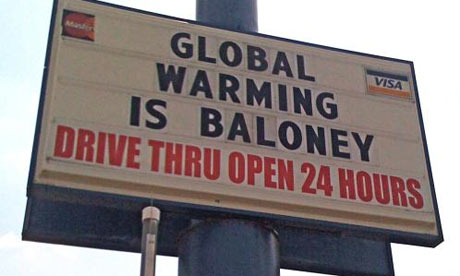
What do you think when you see a sign like this?


Especially when its in front of a Tennessee Burger King? Chris Davis, a staff writer for the Memphis Flyer, noticed these signs outside two local BKs and decided to look into the matter (I want to pat him on the head and say "Good reporter! That's what good reporters do!"), and made some phone calls. The upshot? Burger King's CEO gets it-- John Chidsey has been quoted as saying that climate change is "an overriding issue of importance for the global community, business community and people in general." But the head of Mirabile Investment Corporation apparently doesn't get it--and his company owns more than 40 Burger Kings across Tennessee, Arkansas and Mississippi, as well as a handful of Popeyes and All In One franchises.And the signs have been showing up in front of his restaurants.
So Leo Hickman has picked this story up in
The Guardian, and The Memphis Flyer has the follow up.


Powered by ScribeFire.

Wednesday, May 27, 2009

Tool Use--Not So Damn Smart?

Turns out the last remaining dinosaurs are pretty damned smart when it comes to tool use. Captivity-reared rooks (corvids, part of the same family that counts crows and ravens) not only can solve tool-use puzzles, but can translate that solution to new puzzles. And, as we've seen before, they can also create tools from components--taking a bit of wire and bending it into a hook in order to access food bits. The Guardian website is hosting a lovely bit of video that shows a rook first using a large rock to release a reward snack, and then facing the same problem, but this time with a different sized tube. The rook first leans toward the large rock it used in the first case, but then realizes that the tube is smaller, and grabs the small rock to release the snack.
To quote the article:
Corvids are among the most social of bird species, and it is thought their intelligence helps them to recognise each other. The birds do not appear to have evolved tool skills, but are simply intelligent enough to work out how they can help.

So intelligence doesn't necessarily have anything to do with tool use. Ain't that a kick in the head?

Tuesday, February 3, 2009

6' 30" with David Attenborough

Take a break. Enjoy the story. As PZ Myers says "a bit too phenomenological and definitely too animal-centric, but who cares?"


Powered by ScribeFire.

Monday, December 29, 2008

Water Stress

The Telegraph is reporting on a new report from the Environment Agency that some 24 million people in Britain and Wales are in areas of "water stress;" that is, an area where a bad year for rainfall means there simply will not be enough water.
"[The report] warns that many rivers, lakes, estuaries and aquifers are already
being drained so low that there is a danger to wildlife and a risk to
public supplies in dry years." It also warns that these households have less water available per person than the populations of Morocco and Egypt have. Average water use in the UK is 148 litres/day with a high of 170 litres/day in the south-east of England.
And global climate change is just getting started. Here on Vancouver Island, we get plenty of precipitation during the winter, but it must be carefully managed to get us through the two to three months a year when we get no appreciable rainfall. Worldwide, not only do we not have a lot of room to manoeuvre, but in many places we've no room left at all.


Powered by ScribeFire.

Sunday, December 21, 2008

Nope, no bad news

Plankton captured in stunning close up photographs - Telegraph
Just an article about a scientist photographing plankton. Once you've read the article, see more of the pictures:

Plankton captured in stunning close up photographs - Telegraph

Ah, the world. "It's such a brilliant place. Boom de ah dah, boom de ah dah...."


Powered by ScribeFire.

Tuesday, December 16, 2008

From Russia Today

Comes this intriguing story:

December 16, 2008, 14:54

Anachronous discovery: Swiss watch in ancient tomb

Chinese archaeologists have found a tiny Swiss watch in a tomb dating back to the Ming dynasty, which they believed has been intact for four centuries.

The watch was discovered by scientists making a documentary, reports ananova.com website. The out-of-time piece of jewellery was pressed into the soil covering one of the coffins. The watch is stopped at 10:06, and there is the word “Swiss” on its back.


Work at the archaeological site has been suspended and experts from Beijing have been called in to help solve this mystery, which appears to belong in a sci-fi flick.

Powered by ScribeFire.

Monday, December 15, 2008

Philosophy of Science: A Very Short Introduction

Philosophy of Science: A Very Short Introduction #67
Samir Okasha
Oxford ; New York : Oxford University Press, ©2002
144 p. Includes bibliographical references and index

    It has been a particular pleasure to read this Very Short Introduction, as many of the philosophers mentioned in it I haven't thought about for quite some time. So to remake their acquaintance has been fun.
    This is not so much a book about scientific investigation as it is an open question about how we know what we know from those investigations.  So I read with delight how David Hume (who's alcohol consumption is apparently legendary, allowing him to out-consume  other philosophers) says simply that we cannot rationally justify inductive reasoning, and although we use inductive reasoning regularly (the sun's come up every day up until now, so it should come up tomorrow), that doesn't make it right.  The idea that arguing in favour of inductive reasoning is, in itself, inductive reasoning and quickly develops circularity, is exciting to me, reminding me that big questions are still out there to be debated.
    Samir Okasha leads us through these Big Questions with assurance ind intelligence. His goal is not to argue in favour of any of them, but to explore the history of ideas and the criticisms of those ideas.  His illustrations are generally deceptively simple and clear, illuminating the philosophical problems under discussion with grace and ease.
    As an example, he presents the problem of  what exactly is scientific explanation? And what does it mean to say that a problem can be explained by science?  Okasha begins with a philosopher I hadn't previously encountered; Carl Hempel. After a brief recap of Hempel's “covering law” model of explanation,  Okasha develops a schematic of Hempel's model:

General laws
Particular facts
=>
Phenomenon to be explained

To quote  Okasha, “...Hempel's model is called the covering law model of explanation. For according to the model, the essence of explanation is to show that the phenomenon to be explained is 'covered' by some general law of nature.”  So far, so good. But there are critics of Hempel who suggest that his covering law model allows in things that should be excluded. As an example,  Okasha writes out a thought experiment:
    Suppose you are lying on the beach on a sunny day, and you notice that a flagpole is casting a shadow of 20 metres across the sand. So why, someone asks, is the shadow 20 metres long?
    The answer is fairly straightforward: The elevation of the sun in 37°, and light travels in a straight line (straight enough for the purposes of this discussion, anyway). The flagpole is 15 metres high. The trig calculation indicates that the shadow will be 20 metres long.
    So far so good. General laws= light travels in straight lines and trigonometric laws. Particular facts= angle of elevation of the sun and height of the flagpole. Phenomenon to be explained=the 20 metre long shadow.
    But what if we change the explanandum (the phenomenon being explained)? Let's change it to the height of the flagpole.  In our case above, this simply swaps the length of the shadow into the “particular facts” group and the height of the flagpole into the “phenomenon being explained” group.  But something odd happens—the explanation doesn't really fit. Mathematically it is true. But as an explanation as to why the flagpole is 15 metres high, well, it falls down. The flagpole is what it is for completely different reasons: the contract to install the flagpole specified the height, that was the only flagpole available, whatever. So while the “answer” conforms to Hempel's model, it allows something to stand as a scientific explanation that is clearly incorrect except mathematically.

    So we have questions raised about whether explanation and prediction are simply two sides of the same coin, or radically different concepts.  And  Okasha opens these questions with a simple example that allows us to see the underlying philosophical questions.   Okasha does this again and again, asking whether a theory is really to describe hidden facts (ie.  gases really do contain molecules in motion) or  are they just a way to predict observations? And what is the difference? Or do we trust scientific paradigms or treat them with a certain amount of scepticism? After all, they do change, and they do change radically (think of the change from the Ptolemaic to Copernican paradigm).
    Reading  Philosophy of Science gave me the feeling of being at play in the realm of pure thought—a lovely place to be, and one I haven't visited all that recently.  Quite the delightful Very Short Introduction.


Powered by ScribeFire.

Saturday, December 13, 2008

One Step--Just One--That Can Help Us Now

White roofs could lower global emissions

Changing the color of roofs and pavement worldwide could potentially offset nearly a year’s worth of global CO2 emissions, according to a study released this week at the Conference on Climate Change in Sacramento, Calif.

Painting a single 1,000 square-foot dark roof white would reduce carbon emissions by 10 metric tons, according to Lawrence Berkeley National Laboratory scientists Hashem Akbari and Surabi Menon and California Energy Commissioner Art Rosenfeld. And changing the color of roofs and pavement in 100 of the world’s largest cities could reduce global emissions by 44 billion metric tons, the researchers said.


The world produced 49 billion metric tons of emissions in 2004, according to the Intergovernmental Panel on Climate Change.

"This simple and effective idea can organize the world into taking measured steps to mitigate global warming,” Akbari said in a news release. “Our findings will help city leaders and urban planners quantify the amount of CO2 they can offset using white roofs and cool pavements.”

White roofs could cut energy use by buildings by 20 percent, the researchers said. The equivalent energy reduction would save the U.S. $1 billion a year in energy costs.

California has already adopted energy-efficient roofing standards. It has mandated since 2005 that flat roofs on commercial buildings must be white.

In 2009, the state will expand the regulation to require cool-colored roofs for flat and sloped roofs on residential and commercial buildings, as well as retrofitted buildings. The state has no similar regulations for the color of pavement.

And you can find the report here.


Powered by ScribeFire.

Thursday, December 11, 2008

What Do You Want To Bet

that this will get their attention?

People affected by worsening storms, heatwaves and floods could soon be able to sue the oil and power companies they blame for global warming, a leading climate expert has said.

Myles Allen, a physicist at Oxford University, said a breakthrough that allows cientists to judge the role man-made climate change played in extreme weather events could see a rush to the courts over the next decade.

He said: "We are starting to get to the point that when an adverse weather event occurs we can quantify how much more likely it was made by human activity. And people adversely affected by climate change today are in a position to document and quantify their losses. This is going to be hugely important."

Allen's team has used the new technique to work out whether global warming worsened the UK floods in autumn 2000, which inundated 10,000 properties, disrupted power supplies and led to train services being cancelled, motorways closed and 11,000 people evacuated from their homes - at a total cost of £1bn.

He would not comment on the results before publication, but said people affected by floods could "potentially" use a positive finding to begin legal action.

Of course this is from The Guardian. Somehow this isn't a story in Canada....


Powered by ScribeFire.

Monday, November 17, 2008

Whale Shark

Never seen a guy so excited about whale shark poo. No, seriously.

Dr Meekan, who is based at the Darwin office of the Australian Institute of Marine Science, was followed by the Natural World team as he has carried out his research on these mysterious fish.

He said: "It does seem rather weird, someone being so excited about seeing whale shark poo. And I'm pretty certain that this is the first time it has been filmed.

"But it is pretty rare - they are usually doing their business down in much deeper water."

He described the faeces that the team collected as "scientific gold".

The BBC website has a report including both the footage of the whale shark taking a dump (Woo! That made my morning!) as well as footage of the attachment of a camera to the shark. I found it interesting when Dr. Meekan says "there's a number of behaviours I can't explain." Like the whale shark doing a tail-stand and sinking into the ocean. What is up with that?


Powered by ScribeFire.

Wednesday, November 12, 2008

More On The Census of Marine Life

This is by Stephen Leahy and comes from the Inter Press Service website--though you'd think at least one Canadian news service would carry the story....

UXBRIDGE, Canada, Nov 11 (IPS) - A thousand points of light are being shone into the dark ocean depths as scientists from 82 countries work to complete the decade-long global research effort called the Census of Marine Life.

"It's been a remarkable time of exciting new discoveries and frightening revelations of how quickly the oceans are changing," said Canadian deep-sea biologist Paul Snelgrove, a leader of a team integrating findings from all 17 census projects.

"We were startled to discover small crustaceans never seen by scientists before completely blanketing the seafloor at 500 metres in the Gulf of Mexico," Snelgrove told IPS.

And during the eight years the census has run so far, scientists have documented that more than 90 percent of the oceans' top predators -- large sharks, tunas, swordfish, cod and others -- are now gone and those remaining are in serious trouble. "We're also seeing evidence of climate change with the shifting distribution of species," he said.

I recommend reading the rest of the article.


Powered by ScribeFire.

Breath Samples From Whales

BBC NEWS | Science & Environment | How do you breathalyse a whale?

Gotta say, this is kinda cool. How do you get a breath sample from a whale? Well, you use a helicopter. The Beeb's new series Oceans has the gang on board a ship in the Sea of Cortez (also known as the Gulf of California) taking what seem to be non-invasive breath samples from sperm whales. Overall, they manage to get samples from about 60 whales--and additional samples from another 40 whales of various species off Gibraltar. The most telling moment in the excerpt, for me, is when the presenter says that some of the microbes captured in the spray may have been transmitted to the whales from humans--likely whale-watching humans.


Powered by ScribeFire.