Wednesday, September 12, 2012

The Pre-Raphaelites at Tate Britain

Photograph: Guy Bell for the Guardian

There's a new exhibit opening at the Tate in the UK featuring the pre Raphaelites which tries to place them, historically, as a Victorian avant-garde. Jonathan Jones has written an excellent essay in the Guardian reviewing the show. You've gotta love the opening paragraph:
Tate Britain's new Pre-Raphaelites exhibition is a steam-punk triumph, a raw and rollicking resurrection of the attitudes, ideas and passions of our engineering, imperialist, industrialist, capitalist and novel-writing ancestors. The pistons are pounding, the steam is hissing, cigars are being lit and secret lives once more being concealed. The Victorians are back in town. This is as much a costume drama as a show, jam-packed with heroes and villains and innocent victims, holding up a lurid mirror to the age that built Britain.

Tuesday, September 11, 2012

Business As Usual

From the Grain website


What do you think of when you hear the phrase "Green Economy"? Maybe you get warm and fuzzy, thinking about small artisans and market gardeners pursuing making a local and sustainable living? Or maybe you think a bit bigger, about factories turning out solar panels and low-energy light bulbs. If you're the folks at Grain, you think a bit differently, and write an "article [which] examines the real intentions behind the proposals for a "Green Economy". It is the introductory chapter to a Compendium on the Green Economy that was prepared as a common position for RIO+20 and that was published collectively in Spanish by GRAIN, Alianza Biodiversidad, World Rainforest Movement (WRM), and Friends of the Earth Latin America and the Caribbean (ATALC)." When you're at Grain, you thnk about how the "Green Economy" is maybe just another excuse for business as usual.
Grain's new publication is called Behind the 'Green Economy': Profiting from environmental and climate crisis, and the introduction is available online. It discusses the economy of scarcity, and, with a world economy based on scarcity, the lengths trans-national corporations will go to in order to ensure scarcity in order to maintain their business model:
Destruction, of course, has its limits. Somewhere, at a certain level, of which we are unaware, there is a limit where the climate’s dysfunction or the destruction of all the ecosystems will stop being a source of profit and will become a problem that cannot be ignored, even for the owners of big business. That is why they found it necessary to consider secondary strategies.
One such plan, projected as possibly the most important in the future is that of seizing, controlling and physically monopolising reserves where nature can supposedly continue to function adequately or appropriating spaces that contain the resources essential for mitigating the effects of the crisis. This is the second role that privatisation plays. Herein lies the logic behind land grabbing, for instance. As agriculture becomes more difficult, it will be increasingly advantageous, from a business point of view, to possess or control cultivable land for the short or long term. We find similar reasoning and logic behind new concessions for fishing in cold waters, or the frenzy of privatisation of national parks and natural reserves, or the buying up of huge expanses of natural vegetation, either in tropical forest zones, or in the extreme south of South America.
Under the logic of expanding business possibilities, the physical control of large areas of land plays another important role: to stop populations, and in particular rural populations, from evading mechanisms of dependency. Eighty-five per cent of peasant and indigenous families all over the world have access to less than two hectares of land.15 With all the legal, technical, and political hurdles that peasant and indigenous agriculture is faced with, relations with the market develop in irregular ways, with resistance coming and going according to the different circumstances. Big businesses and financial entities seem to have learnt the lesson that as long as they have control over their own resources, the people of the countryside will always be able to resist them with their capacity for autonomy. The response, again: total dispossession.
Whether it’s under the guise of protection against environmental devastation, or under the guise of disarming mechanisms of evasion and resistance, or if it is simply about making profits, the seizure and control of large areas of land has become a useful strategy for businesses. This process works in conjunction with the forced removal of families, communities and people from their homes, lands and territories. This is what we have observed more and more frequently. Whether forced removals or dispossession are undertaken “calmly” or whether they are done by means of open warfare depends in large part on the character of the governments that cooperate with the investors to repress people.

Monday, September 10, 2012

Hmm. Who To Believe...

The Guardian (and others) are reporting on a new report from Human Rights Watch, alleging:
Human Rights Watch (HRW) has accused the US government of covering up the extent of waterboarding at secret CIA prisons, alleging that Libyan opponents of Muammar Gaddafi were subjected to the torture before being handed over to the former dictator's security police.
The New York-based human rights group has cast "serious doubt" on Washington's claim that only three people, all members of al-Qaida, were waterboarded in American custody, claiming in a new report to have fresh evidence that the CIA used the technique to simulate drowning on Libyans snatched from countries in Africa and Asia.
The report, Delivered into Enemy Hands: US-Led Abuse and Rendition of Opponents to Gaddafi's Libya, also says that the CIA, Britain's MI6 and other western intelligence services were responsible for "delivering Gaddafi his enemies on a silver platter" by sending the captured men to Tripoli for further abuse after the American interrogations.
"only three people, all members of al-Qaida, were waterboarded in American custody" Now, two things spring to mind. First, the acknowledgement that three people were waterboarded opens up members of the Bush administration to charges of torture at the International Criminal Court. Now that it's been acknowledged, this should make arrest easier in any country other than the US.
Second, do I believe them that they only tortured three people? I certainly can't think of any other country that has restricted its use of torture so strictly. By the time you've begun torturing, you've pretty much abandoned "civilized" behaviour. So no, I don't believe them. Do I think that HRW might make a few mistakes, be mislead by others for their own political ends? Of course. Which is why I think members of the Bush administration should be standing trial. Courts may be imperfect, but they are the best venue we currently have for determining were the truth lies when we're faced with a Rashomon situation.

Saturday, September 8, 2012

We Know Mitt Has Money...

...but just where did it come from? Matt Taibbi, contributing editor to Rolling Stone, knows.
Matt Taibbi, from his RS blog

And he knows because he's one of the few willing to do a bit of legwork to understand just how Mitt Romney became so wealthy. And he'd like you to know, too. So he was on Democracy Now! with Amy Goodman (one of the very few other journalists willing to do legwork) to tell you. And it's the story of late-stage capitalism. From the interview (transcript) (original program audio):
Well, Mitt Romney is really the representative of an entire movement that’s taken over the American business world in the last couple of decades. You know, America used to be—especially the American economy was built upon this brick-and-mortar industrial economy, where we had factories, we built stuff, and we sold it here in America, and we exported it all over the world. That manufacturing economy was the foundation for our wealth and power for a couple of centuries. And then, in the '80s, we started to transform ourselves from a manufacturing economy to a financial economy. And that process, which, you know, on Wall Street we call financialization, was really led that—sort of this revolution, where instead of making products, we made transactions, we made financial products, like credit default swaps and collateralized debt obligations. We created money through financial transactions rather than building products and selling them around the world. And that revolution was really led by people like Mitt Romney. And the advantage of financialization, from the point of view of the very rich and the people who run the American economy, is that it was extremely efficient at extracting wealth and kicking it upward, whereas the old manufacturing economy had the sort of negative effect of spreading around to the entire population. In the financialization revolution, you can take all of the money, and you don't have to spread it around with anybody. And Mitt Romney was kind of a symbol of that fundamental shift in our economy
 Matt's original article, Greed and Debt: The True Story of Mitt Romney and Bain Capital appeared in Rolling Stone.  The appearance of the article raised a lot of questions, and one major piece which tried to refute it. Matt took the time to answer the criticism.

Friday, September 7, 2012

One Step Closer

George Monbiot, from his website

One of the principals of democracy is that all persons are equal before the law. That this is not so is pretty much self-evident, does not need me listing case after case as proof, and is one of the major failings of our system. But we're getting one step closer, at least in the UK.
Public intellectual and professional gadfly George Monbiot has set up a bounty fund to further the attempt to bring former UK PM Tony Blair to account in front of the International Criminal Court at the Hague. He also wrote a piece September 3rd about how the philosophical and societal support for different types of justice for different people is beginning to crack apart. An excellent article, and well worth reading more than this excerpt:
For years it seems impregnable, then suddenly the citadel collapses. An ideology, a fact, a regime appears fixed, unshakeable, almost geological. Then an inch of mortar falls, and the stonework begins to slide. Something of this kind happened over the weekend.
When Desmond Tutu wrote that Tony Blair should be treading the path to The Hague, he de-normalised what Blair has done. Tutu broke the protocol of power – the implicit accord between those who flit from one grand meeting to another – and named his crime. I expect that Blair will never recover from it.
The offence is known by two names in international law: the crime of aggression and a crime against peace. It is defined by the Nuremberg principles as the "planning, preparation, initiation or waging of a war of aggression". This means a war fought for a purpose other than self-defence: in other words outwith articles 33 and 51 of the UN Charter.
That the invasion of Iraq falls into this category looks indisputable. Blair's cabinet ministers knew it, and told him so. His attorney general warned that there were just three ways in which it could be legally justified: "self-defence, humanitarian intervention, or UN security council authorisation. The first and second could not be the base in this case." Blair tried and failed to obtain the third.

Thursday, September 6, 2012

Wednesday, September 5, 2012

After Capitalism

In the vein of becoming the change we want to see in the world, The Guardian is hosting a forum called "After Capitalism."
In the following animation, George Monbiot takes on something of what we mean by "capitalism" and what a different future might hold.

Mr. Monbiot has taken the time to post the text of the video.
To answer the question of what the world will look like after capitalism, we first have to decide what we mean by capitalism. If it means a system that arises from lending money at interest, then there will be no “after capitalism”. Even when usury was banned on pain of execution or excommunication, it continued, so powerful was the profit drive. While executing bankers has much to commend it, it’s likely to be ineffective. Lesser measures would produce even poorer results.
If on the other hand capitalism means something like the current dispensation, which allows a few people to seize much of the wealth generated by everyone, which blocks social mobility, which re-engineers the political system to serve the economic elite, then, yes, there’s a lot we can do about it.
For the past 200 years, men and women have fought stoicly for political democracy. Now we should fight for economic democracy. The natural wealth of the world, its land, its soils, its crops, minerals, water, forests, fish, is limited. The wealth arising from its use and multiplied through all the complex layers of the modern economy, is also limited, bounded ultimately, as the subprime mortgage crisis showed us, by the real value of assets in the physical world. Just as it was wrong for monarchs and aristocrats to concentrate so much political power in their hands, so it is wrong that billionaires and corporations should be permitted to seize so much of the common treasury of humankind: the wealth arising from the use of a finite planet.

Tuesday, September 4, 2012

Environmental Overshoot

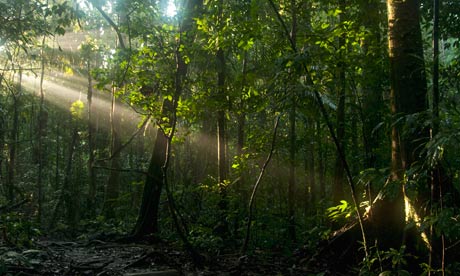
Yasuni national park is the most biodiverse region on Earth.
Photograph: Corbis via The Guardian


From The Guardian:
In international bodies, biodiversity loss was long treated as a poor cousin to climate change. But this is changing amid growing awareness that both are approaching dangerous tipping points as a result of human pressures. Earlier this year, a group of leading scientists warned that biodiversity loss could result in a "global-scale state shift".
"Much as the consensus statements by doctors led to public warnings that tobacco use is harmful to your health, this is a consensus statement by experts who agree that loss of Earth's wild species will be harmful to the world's ecosystems and may harm society by reducing ecosystem services that are essential to human health and prosperity," noted Prof Bradley Cardinale, an associate professor at the University of Michigan who led the study published in Nature. "We need to take biodiversity loss far more seriously – from individuals to international governing bodies – and take greater action to prevent further losses of species."
But the trend is in the opposite direction. WWF says we are in an ecological overshoot situation in which it now takes 1.5 years for the Earth to regenerate what we use in a year. [emphasis mine]

Thursday, August 23, 2012

Not Much To Add

...as the stealth program to convert Canada into a banana republic continues apace. Our military command structure is now completely subsumed in the American one and the "War On Terror "continues to target North American citizens who speak about about the direction our lords and masters are taking us.
From The Tyee:
A top lawyer at the world's largest civil liberties organization warns that Canada's increasing participation in the so-called "War on Terror" has jeopardized democracy.
The unchecked political influence of "deep state" spy agencies -- whether the U.S. Central Intelligence Agency (CIA) or our own Canadian Security and Intelligence Service (CSIS) -- is threatening citizens' ability to hold the state accountable, says Jameel Jaffer, deputy legal director of the American Civil Liberties Union (ACLU).
"The larger idea that we are engaged in a global war against terrorism (is) a very dangerous idea," Jaffer told the Tyee, where he addressed a BC Civil Liberties Association (BCCLA) event on Monday. "It's a dangerous proposition that we are involved in this war that has no temporal boundary, no geographic boundary, and is against an enemy that is really difficult to identify.
"(It's) drastic and radical: it's to propose that we're in a forever war and in an everywhere war... In Canada, the Charter is a very useful tool for litigators and public interest advocates to use in articulating arguments against these kinds of counter-terrorism policies that are inconsistent with democratic values."

Wednesday, February 16, 2011

Agent Provocateur

No, not the lingerie company. Rather the infiltration of civic groups (typically radical or interested in progressive causes) by police or other security organizations in order to incite violent or illegal actions. Like Mark Kennedy, recently outed in Britain as having spent years undercover in the UK environmental movement. And now the Guardian is reporting on three major energy firms that have employed private security firms to carry out covert intelligence-gathering operations on environmental activists and groups.
Governments in the UK have viewed environmental protest as potentially violent terrorism since at least the rule of Margret Thatcher. Infiltration with agent provocateurs in the US environmental movement go back to the monkeywrenchers of the 80s and even earlier (Nixon's enemy list shows that paranoia has long been a feature of the ruling class south of the border). In Canada, RCMP agent provocateurs were responsible for much of the paranoia around the French-Canadian separatist movement in the 1970s.
George Monbiot reports that he could not find "a single proven instance of a planned attempt in the UK to harm people in the cause of defending the environment". This jibes with reports from the mid-1980s here in the Pacific Northwest when a tremendous panic was being whipped up against "tree spiking," where large nails, it was claimed, were being pounded into trees in order to damage mill machinery. Despite the hysteria whipped up by the local media and public pronouncements from various logging companies, only one incident of possible tree spiking was reported when, in 1987, California mill worker George Alexander was seriously injured when the bandsaw he was operating was shattered by either an old nail or a tree spike. One unproven case of possible spiking became the basis for tree spiking being declared a federal felony in the United States in 1988.
The agent provocateur is an excellent tactic for keeping track of a group while simultaneously discrediting it. Which, of course is why it's used. But there are some actions that such agents really cannot guard against. Like the new Greenpeace ad.


Saturday, January 15, 2011

Caustic and Cutting

With Carlin dead, I can only be talking about Bill Maher. His take on why the American founding fathers would have thought the teabaggers are idiots is more than worth the price of watching.

Thursday, January 13, 2011

Just Watching a Video

So I've got, at last count, a baker's dozen videos up on YouTube. Mostly, they are there so that I can link to them from one of the blogs, and I count myself lucky when one of them gets to two hundred views (as both Paula kayaking rapids in Sooke River and my interview with John Rogers have done). In order to be able to embed a video of the world's largest beaver dam, I copied a Canadian Government vid over to YouTube and was astonished when it suddenly ended up with over a thousand views. Turns out, the topic was covered on Ellen and I was a collateral beneficiary.

Last April, I posted a vid of the salmon spawning in Goldstream River--mostly so my sister could show her kids what it looks like. Or friends could show their kids. Whatever. But over the last week, I've received over 8,400 views of this little two-and-a-half minute video.

It turns out that a little over a week ago, some idiot threw a leak tracing chemical into Goldstream River, turning it bright green for a period. Thankfully, it should be non-toxic and have no lasting damage on the river. But what it means is that all of a sudden a lot of people were looking for video of Goldstream River. And, once again, I was a collateral beneficiary.

And, of course, once you start getting views, you move up the rankings, which makes it easier to find you and get more views--so the world's largest beaver dam is now sitting at over two thousand views. But the weird feeling I have is from the fact that I really didn't do anything to get these views. Ellen DeGeneres covered the beaver dam story, people stumbled over my video. Same with the green Goldstream story. I didn't auto-tune the news, or set up a stunt that caused me to be horribly injured in a really funny way, or anything like that.

Neither of these videos has gone viral. But it has made me a little more sensitive to the vagaries of internet memes and internet "fame". Sh*t happens, and often, it has nothing to do with you. Sometimes it's just a Lolcat.

Friday, December 31, 2010

Hellhounds on your trail

"If only part of the things brought out prove true, These men have done the American people more damage than all the incidental operations of Al Capone. Capone had the merit of confining his robbery and the infliction of physical violence to the wicked.... [I]f these stories are true these men are not bankers , they are banksters who rob the poor, drive the innocent to poverty and suicide and do infinite injury to those who honestly work and strive. Worse than that, they are traitors to our institutions and national ideas."
        US president Herbert Hoover 1933.

    As 2010 closes out, we're two years into a Democratic administration in the US and at least two years into the worst speculative bubble since the Crash of '29. Praise must go to the Obama administration for their masterful work in preserving the international financial system without actually making any systemic changes to help prevent a recurrence of the same problems. That there is any confidence in the international financial system is testament to the loosely coordinated international effort to disguise the depth of the problems from the public at large while desperately injecting trillions of dollars into resuscitating the system.
    In the US, the administration is allowing millions of foreclosures to go forward under the same conditions that prevailed during the issuing of the original mortgages; that is, a system without protection for the consumer, with perverse incentives built in that breed casualness, incompetence, and outright fraud, and where the 91% of US citizens who consider themselves "middle class" are cheated, lied to, and exploited. (Personally, I love the stories of the people who have frozen the foreclosure proceedings on their homes by the simple act of asking the foreclosing bank to prove that they actually hold the mortgage on the property. With the extensive collateralization and re-collateralization of these debt obligations, the actual ownership of even a portion of a mortgage is often impossible to define).
    The only real difference between this crash and the Crash of '29 is that this time there isn't the panic of depositors trying to get their money out of the bank before the bank fails. The creation of federal deposit insurance has kept the banks, and the countries they do business in, liquid.  But after the Crash in '29, it took the US four years and a change in administration (from Hoover to Roosevelt) before the excesses and failures were recognized and corrective legislation was considered. It is depressing that the most important corrective, the Glass-Steagall act separating commercial from investment banking--repealed under Reagan, seems to be at the heart of the current series of speculative boom and bust cycles. And it is even more depressing that one of the same banks, Citigroup, is again at the epicentre of the crisis.
    There are differences between crashes; the last time it took years for the tricksterism, fraud, and near-criminality to be exposed. This time there are plenty of books and information being generated on the same topics, although they are being presented in formats that most people (particularly in the US) no longer access (books and newspapers, primarily). But the root causes of the crisis' are pretty much identical. Roosevelt intimate and (eventual) Supreme Court justice Felix Frankfurter wrote that:

    [I do] not believe that vice inheres in the rich and virtue in the poor. But for too long we have been largely operating on the assumption that the converse is the truth, and more particularly that the rich are the guardians of wisdom and should control affairs.... The crux of the business is not the wickedness of the Mitchells [head of City Bank in 1933] but the power which is wielded by concentration of financial  power which they are wholly unworthy--no matter who they are--to wield because of the obfuscations and the arrogances which power almost invariably generates. [sic]
       (quoted in Hellhound of Wall Street, Michael Perino, page 223)

    People are no smarter today than 80 years ago (in many respects, they're more ignorant), and although we have some experience with worldwide financial crisis', our governments are still allowing laws to be written by the same group of people the same laws are meant to regulate, we still fall under the spell of the same slogans ("Greed is Good") and economic theories (the Chicago School, neo-liberalism, laissez-faire). The same people selling CDOs knew that a crash was coming--which led them to re-double their efforts to sell more of them in order to get their money while the getting was good. All we've really changed is the degree to which our economies are interlinked. And we still persist in our view that crashes and speculative bubbles are aberrant, rather than the normal operation of the financial system we live under. Welcome to a new decade.

Monday, November 29, 2010

Liars, Damned Liars and the Conservative Party

    The Toronto Star /  Canadian Press Service are reporting that despite repeated claims that the Canadian government would address global warming and GHG emissions in step with the United States, Environment Minister John Baird has stated that this will not happen.
    With the failure to institute cap and trade in the US, the Obama administration has announced a "Plan B," passed by executive order, that strengthens the EPA regulation over greenhouse gasses. To quote the article:
    The first step tightens rules for existing facilities planning any expansion that would increase emissions. Then, starting in July, the rules will be extended to include newly constructed facilities.
    The EPA says its regulations target operations that produce nearly 70 per cent of U.S. greenhouse gas emissions from stationary sources.
    The agency estimates the more stringent rules will require first-time permits for about 550 sources between 2011 and 2013. It also expects an additional 900 permits for new and modified projects each year.
    Although the EPA regulations are national, Texas has announced that the state will refuse to meet the federal guidelines. Baird offers the excuse that because of this refusal, this makes the US regulations "not national."
    Frankly, this position is absurd. It is the equivalent to suggesting that because Alberta has argued with, and been in contravention of, aspects of our national healthcare program, that this invalidates Medicare. It was not true in the case of Medicare, and it certainly isn't true in the case of the new EPA regulations.
    The Conservative Party has been relying on the American Republicans tactics of lies, denial, and fear to keep any meaningful change in American policy on GHGs from being enacted. With the strengthening of EPA regulation by the White House, this claim that "when the Americans do something, we'll do something" has been rendered moot. The Americans have done something-- and, importantly, something that could make a difference here in Canada. They have targeted GHG emissions from stationary sources. In Canada, that means only one thing; the Alberta tar sands projects.
    If the Conservatives were to actually harmonize Canadian environmental regulation with the US, this would force greater efficiencies on the tar sands projects, possibly restricting their (currently a cancer-like unrestrained) growth. It would do nothing to address the appalling waste handling in the tar sands, nor would it do anything to deal with tailpipe emissions (a 1970s problem addressed by a Conservative proposal to harmonize Canadian regulation with American earlier this year).
    The Conservative Party under Stephen Harper has made it abundantly clear that they will not, under any circumstances, do anything that might slow the exploitation of the tar sands, or that would impose any kind of regulation on them. This does, from their point of view, make sense; any regulation of the tar sands would raise, in Alberta, the spectre of the hated National Energy Program. Which, of course, would mean political suicide for the Tories in Oilberta. The Tories have recognized that opposing corporate interests, particularly in the oil patch, particularly in Alberta, is a non-starter. This despite the fact that most Albertans couldn't have told you what the NEP was about in the '70s, never mind now.
    In our current irony-impaired environment, Baird made his comments while preparing to attend the United Nations Climate Change Conference that begins this week in Cancun, Mexico.

Friday, October 15, 2010

Water

    I currently live in a temperate rainforest--or what used to be one. I live next to the ocean beside a park that is at or below the high tide level and only survives because of the massive amounts of fill that was trucked in 60 years ago. For six months of the year, we are regularly inundated with rain. And yet...and yet...for at least two months a year, this temperate rainforest does without rain.
Previous to moving back here, my family and I spent 14 years living on a farm north of Edmonton, Alberta. By the time we left, we had watched the land dry out and drift in front of the wind, like snow in winter.
    For most of the time we lived on the farm, the biggest problems were getting water into the house, and getting water out of the house. We had a dug well (as opposed to a drilled well), which meant that we were dependent on water held in the first thirty metres or so of soil. The first five years, I climbed down the well and scooped the dead gophers (technically, Richardson's Ground Squirrels) off the surface of the water two or three times a year. Eventually we re-dug the well and solved that problem. But in the meantime, we just boiled water and tried not to think about it.
    The water we drank, cooked, and generally used wasn't great--it had a high nitrate content--but it was usable. Unlike, say, the Athabasca River running past Fort MacMurray and the oilsands. But the Athabasca River only affects the Northern Cree of Oilberta, so that really doesn't count.
    I had never thought of there being a water problem in Alberta. There had always been water while I was growing up there. The winters had snow, the spring, summer, and fall had rain. And when you turned the tap on, water came out--as much as you could want.
    But there were a few factors that I wasn't aware of, growing up. Like Edmonton hadn't yet reached a million people, as it did a couple of years back. That glacial run-off did a good job of maintaining summertime flow in the North Saskatchewan River, just like it did in the Bow River running through Calgary. And the big one; that we were living through the wettest century in two thousand years.
    Alberta wasn't even a century old as a province back then. All our weather and water information was based on the century we were living through. We had been through six major drought events, including the "Dirty Thirties," but those events were anomalies, unusual, abnormal. the problem wasn't availability of water, but the distribution. And so the provincial government subsidized irrigation projects aimed at the area south of red Deer, and planned a massive water diversion project that would take the water flowing north and re-direct it south. Part of it for southern agriculture, and part of it for export into the United States. As the oil-patch became the primary political driver in the province, permits for water were approved that removed acre-feet of potable water out of the southern river systems to pump down played-out oil wells, forcing the last of the oil out and permanently removing the now-contaminated water from the water cycle.
    And even though Alberta elects its governments for multi-decade reigns, there was, and is, no long-term thinking about resource issues in the province. Especially water issues. There is resource "management," where fair access is managed, but never any thinking about whether water should be used in the ways we use it.
    And getting water in and out of the house is really one of the driving forces of civilization, like access to food and taxation. Here where I live now, in Victoria, there's a major fight going on over sewage treatment--aka getting water out of the house. In Alberta, there's agreements in place with Saskatchewan over how much water can be taken by each province out of shared rivers, but there's no thinking about how much water is needed by the river system.  We don't simply need batter water management in Canada, we need a serious re-think about how we relate to water. After all, without water there's not really much point to anything else, is there?